PET-CF 3D printing. Properties and uses
Carbon-fibre PET is stiff, holds its shape to 182 °C and takes up little moisture, so parts keep their size. Load-bearing parts for less than PPA-CF.
- 182 °C heat deflection
- Low moisture uptake, stable size
- Usually 1-3 working days
- From a single part
What PET-CF is
Polyester (PET) filled with chopped carbon fibre. It sits between PETG and PPA-CF: far stiffer and more heat-stable than PETG, easier to print and cheaper than PPA-CF.
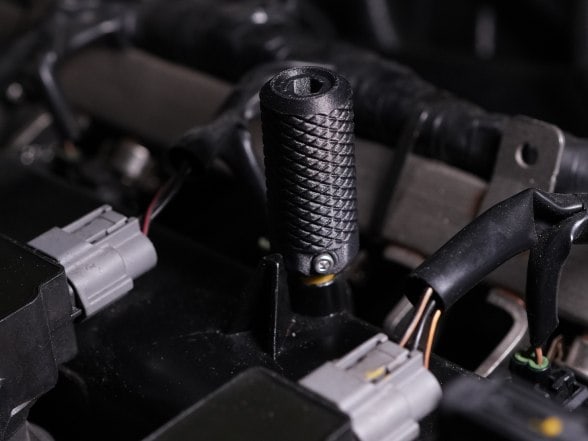
It absorbs little water (0.37% at saturation), so a part keeps its size in a humid hall, and it comes off the printer matte black.
- tensile strength, X-Y
- 74 MPa
- flexural modulus
- 5,320 MPa
- heat deflection, 1.8 MPa
- 182 °C
Manufacturer datasheet values
Datasheet figures
Manufacturer datasheet values (Bambu Lab), measured on test specimens. A printed part also depends on its shape, walls and orientation.
| Property | PET-CF |
|---|---|
| Tensile strength, along the layers (X-Y) | 74 ± 6 MPa |
| Tensile strength, across the layers (Z) | 35 ± 5 MPa |
| Flexural modulus (X-Y) | 5,320 ± 270 MPa |
| Heat deflection at 1.8 MPa | 182 °C |
| Density | 1.29 g/cm³ |
| Water absorption at saturation | 0.37% |
| Chemical resistance | Most oils and grease; not acids, alkalis or some solvents |
Typical parts
Load-bearing parts that sit near heat or in damp places.
Brackets near heat
Mounts and holders beside motors, lamps and heaters.
Motor mounts
Stiff parts that hold a motor steady.
Fixtures and jigs
Workholding that keeps its size through a shift.
Housings
Enclosures for warm cabinets and outdoor boxes.
How we print carbon fibre
Carbon-fibre filaments are hard to print well, and they are among the materials we print most.
Dried first
Every spool is dried before it prints, so the layers bond and the part keeps its strength.
Hardened nozzle
Carbon fibre wears an ordinary nozzle out. Ours is hardened, so every part stays to size.
Heated chamber
A warm chamber holds the part at temperature, so it stays flat and bonded.
Oriented to the load
A part is strongest along its layers, so we turn each one to its load.
Largest part in one piece: 340 x 320 x 340 mm
When to choose something else
- Not for chemicals: acids, alkalis and some solvents attack it. PPS-CF resists them.
- Across the layers it keeps about half its strength (35 MPa against 74 MPa), so we orient the part to its load.
- For the most strength and stiffness, PPA-CF is stronger (168 MPa against 74 MPa).
Questions about PET-CF
PET-CF or PETG?
PET-CF is stiffer (5,320 MPa against 2,050 MPa flexural modulus) and holds heat far better (182 °C against 62 °C heat deflection). PETG costs less and suits everyday parts away from heat.
PET-CF or PPA-CF?
PPA-CF is stronger and stiffer, and costs more. PET-CF is the sensible choice when a part must stay stiff near heat but does not need the strongest material we have.
Is PET-CF good outdoors?
Bambu Lab lists outdoor use among its applications, and its datasheet notes UV and water resistance. Tell us where the part goes and we confirm.
How big can a PET-CF part be?
Up to 340 x 320 x 340 mm in one piece.
How fast can I have it?
Usually 1-3 working days after you approve the price. The quote gives the date.

Stiff, near heat, on a budget?
Send the file. A person checks that PET-CF suits the part and replies with the price.