Asked for ABS? What to print instead
ABS is named on a drawing for one of a few reasons: heat, sun, knocks, chemicals, or habit. Pick the substitute by the reason. PC FR takes more heat than ABS, ASA takes the sun, PETG HF is tougher across the layers, and the ASA family keeps ABS's resistance to acid and alkali. Every figure below is from Bambu Lab's datasheets.
- For heat: PC FR 108 °C against ABS 84 °C heat deflection at 1.8 MPa (ISO 75)
- For sun: ASA or ASA Aero, whose datasheets state UV resistance
- For knocks across the layers: PETG HF 10.6 against ABS 7.4 kJ/m² (ISO 179)
- ASA Aero, PETG HF and PC FR: 2-5 working days after payment; ABS on request, ordered in
What can I print instead of ABS?
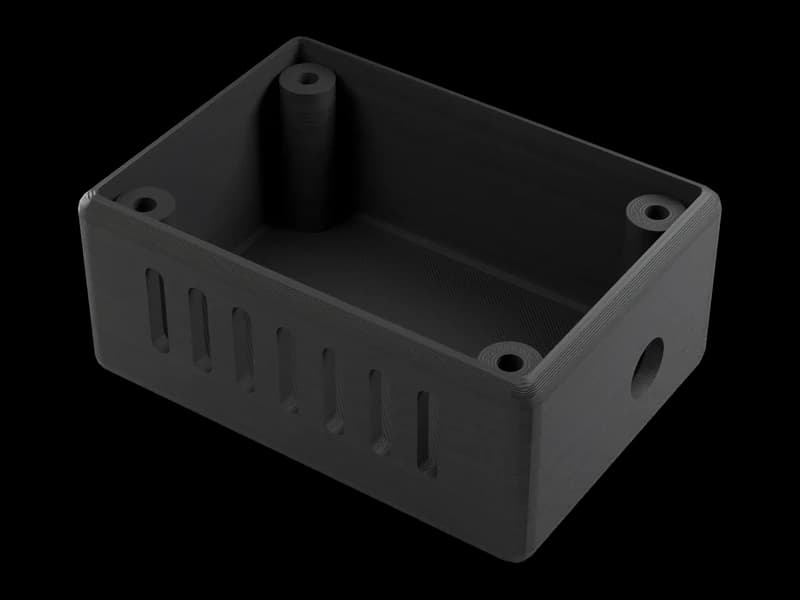
It depends on why ABS was chosen. For heat, PC FR: 108 °C heat deflection at 1.8 MPa against ABS's 84 °C. For sun and weather, ASA or ASA Aero, whose datasheets state UV resistance. For chemicals, ASA or ASA Aero again: both resist acid and alkali like ABS does. For an everyday part in a box or a room, PETG HF, tougher across the layers than ABS, but it softens at 62 °C.
We print ABS on request, ordered in for the job.
ABS and the substitutes side by side
Figures from Bambu Lab's datasheets for ABS (TDS V3.0), ASA (V3.0), ASA Aero (V1.0), PETG HF (V1.0) and PC FR (V1.0), measured on test specimens and given "for design reference and comparison only". Every specimen set was annealed and dried before testing, so the columns compare fairly. X-Y is along the layers, Z across them.
| ABS | ASA | ASA Aero | PETG HF | PC FR | |
|---|---|---|---|---|---|
| Our status | ABSordered in | ASAordered in | ASA Aeromost popular | PETG HFmost popular; white is 24/7 PETG | PC FRmost popular |
| Heat deflection 1.8 / 0.45 MPa (ISO 75) | ABS84 / 87 °C | ASA92 / 100 °C | ASA Aero78 / 85 °C | PETG HF62 / 69 °C | PC FR108 / 113 °C |
| Tensile strength X-Y / Z (ISO 527) | ABS33 / 28 MPa | ASA37 / 31 MPa | ASA Aero32 / 21 MPa | PETG HF34 / 23 MPa | PC FR60 / 21 MPa |
| Impact X-Y, unnotched / notched (ISO 179) | ABS39.3 / 21.5 kJ/m² | ASA41.0 / 19.6 kJ/m² | ASA Aero32.0 / 8.2 kJ/m² | PETG HF31.5 / 6.2 kJ/m² | PC FR55 / 8.4 kJ/m² |
| Impact Z (ISO 179) | ABS7.4 kJ/m² | ASA4.9 kJ/m² | ASA Aero3.4 kJ/m² | PETG HF10.6 kJ/m² | PC FR8.0 kJ/m² |
| UV in the datasheet | ABSnot rated here, see the note | ASA"exceptional UV, weather ... resistance" | ASA Aero"extraordinary resistance to temperature, water, and UV rays" | PETG HFnot stated | PC FRnot stated |
| Acid / alkali | ABSResistant / Resistant | ASAResistant / Resistant | ASA AeroResistant / Resistant | PETG HFNot resistant | PC FRNot resistant |
| Oil and grease | ABSNot resistant to some kinds | ASANot resistant to some kinds | ASA AeroResistant to most kinds | PETG HFResistant to most kinds | PC FRResistant to most kinds |
| Flammability (datasheet) | ABSFlammable | ASAFlammable | ASA AeroFlammable | PETG HFFlammable | PC FRFlame retardant; UL 94 V-0 is Bambu Lab's test of the filament |
| Density (ISO 1183) | ABS1.05 g/cm³ | ASA1.05 g/cm³ | ASA Aero0.99 g/cm³ | PETG HF1.28 g/cm³ | PC FR1.18 g/cm³ |
| Largest part in one piece | ABS340 x 320 x 340 mm | ASA340 x 320 x 340 mm | ASA Aero340 x 320 x 340 mm | PETG HF340 x 320 x 340 mm | PC FR340 x 320 x 340 mm |
The note on UV: Bambu Lab's ABS datasheet names UV resistance in its introduction, and Bambu Lab also calls ASA "a common alternative to ABS, offering improved UV, temperature, and impact resistance". We do not rate ABS for sun either way on this page. The ASA datasheets state UV resistance in words; the PETG HF and PC FR datasheets do not.
Bending modulus is left out because it does not decide anything here (1,510 to 2,050 MPa across the five). Water absorption, for one wet line: PC FR takes up the least at 0.12%, PETG HF 0.40%, ASA 0.45%, ABS 0.65%, ASA Aero 0.80% (25 °C, 55% RH). Read heat deflection as a loaded specimen test, not as a service temperature.
If ABS was chosen for

- HeatGo up, not sideways. PC FR at 108 °C and ASA at 92 °C are above ABS's 84 °C; ASA Aero at 78 °C and PETG HF at 62 °C are below it. A part named ABS for heat should not become PETG. PC FR is one of our most popular materials; ASA is ordered in and the quote gives the time. Above 108 °C, see Filament for parts above 100 °C.
- Sun and weatherASA is ABS's outdoor sibling: the datasheet composition is "acrylonitrile - styrene - acrylate" against ABS's "ABS", and both ASA datasheets state UV resistance. ASA Aero is one of our most popular materials and foams as it prints, so a housing or a cover comes out light; plain ASA is ordered in and is the one for a loaded part. See PETG or ASA for outdoor parts.
- ToughnessSay which direction. Along the layers ABS keeps the highest notched impact of the five (21.5 kJ/m²) and ASA is close (19.6). Across the layers PETG HF is the toughest (10.6 kJ/m²) and PC FR second (8.0), both above ABS (7.4). If the knock or the strain runs across the layers, PETG HF is the substitute.
- ChemicalsABS resists acid and alkali in its datasheet, and so do ASA and ASA Aero. PETG HF and PC FR do not, so neither is the chemical substitute. Of the three that resist acid and alkali, ASA Aero is the only one that also reads "Resistant to most kinds" of oil and grease. For solvents and fuels, none of these; see Chemical-resistant filament.
- HabitIn our 2026 enquiries that name a material, ABS comes second only to PETG, and we ask whether it has to be exactly ABS or PETG will do. For a part that lives in a box or a room, PETG HF is the usual substitute: tougher across the layers, and white on our printers around the clock.
When it has to stay ABS
Sometimes the material is the spec. An approved drawing that names ABS, a part that is solvent-bonded or solvent-smoothed as part of an assembly process, a replacement that must behave exactly like an existing ABS moulding: in those cases a substitute changes the part, and you decide whether that is acceptable.
We print ABS on request: it is ordered in for the job, and the quote gives the time. If your part has to stay ABS, say so in the enquiry. If a substitute is acceptable, say what the part does and we pick between the four substitutes above.
What we print most
ASA Aero, PETG HF and PC FR are on our most popular list: usually 2-5 working days after payment. White PETG HF is 24/7 PETG, with no setup to wait for or pay for. ASA, ABS, PC and ASA-CF are ordered in for the job; the quote gives the time.
ASA, ASA Aero and PC FR need a heated chamber, so the largest part in one piece is 340 x 320 x 340 mm. Tolerance ±0.5%, minimum ±0.5 mm. Parts are posted to the Baltics, Finland, Sweden and Denmark. Ask for two materials in one request and the quote prices each.
Questions
Checked by the druckworks workshopUpdated
Can I use PETG instead of ABS?
For an everyday part in a box or a room, yes: PETG HF is tougher across the layers (10.6 against 7.4 kJ/m², ISO 179) and as strong along them (34 against 33 MPa). Not for heat: it deflects at 62 °C against ABS's 84 °C. Not for acid or alkali: its datasheet says "Not resistant".
Is ASA better than ABS?
For the sun and for heat, on the datasheets: 92 against 84 °C heat deflection at 1.8 MPa, and ASA states UV resistance where we do not rate ABS. Along the layers it is slightly stronger (37 against 33 MPa). Across the layers ABS keeps more impact strength (7.4 against 4.9 kJ/m²). ASA is ordered in; ASA Aero is one of our most popular materials.
Which ABS alternative takes the most heat?
PC FR: 108 °C heat deflection at 1.8 MPa and 113 °C at 0.45 MPa (ISO 75). Then ASA at 92 °C. For more than that, a carbon fibre material: PPA-CF at 196 °C or PPS-CF at 235 °C.
Is PC FR an ABS alternative for electronics housings?
Yes, and often the better one: 108 °C heat deflection, 55 kJ/m² unnotched impact, and "Flame retardant" on its datasheet, where UL 94 V-0 is Bambu Lab's test of the filament, not a rating of your part. See PC FR and 3D printed enclosures for electronics.
Do you print ABS?
We print ABS on request: it is ordered in for the job, and the quote gives the time. If your part has to stay ABS, say so in the enquiry.
Is ASA Aero as strong as ABS?
No. It foams as it prints, so Bambu Lab says prints come out at 50-75% of regular ASA density, and it gives up strength: 21 MPa and 3.4 kJ/m² across the layers. Good for a housing or a cover in the sun; a poor choice for a hook that takes a knock. For a loaded outdoor part, ask for plain ASA.
Is ABS stronger than PETG?
Along the layers they are the same (33 against 34 MPa). ABS takes the harder notched knock along the layers (21.5 against 6.2 kJ/m²); PETG HF takes the harder knock across them (10.6 against 7.4 kJ/m²). ABS deflects 22 °C higher under load: 84 against 62 °C at 1.8 MPa.
Do you post these parts to Sweden?
Yes. We post to Latvia, Estonia, Lithuania, Finland, Sweden and Denmark. The quote names the carrier and the shipping price.

ABS on the drawing?
Send the file and say why ABS was chosen: heat, sun, knocks, chemicals or habit. A person picks between PC FR, ASA, ASA Aero and PETG HF, or tells you if the part should stay ABS, and replies with a price in 3 hours on average on workdays.