Which filament survives oil and solvents
Every Bambu Lab datasheet rates a filament on four rows: acid, alkali, organic solvent, oil and grease. One material answers "Resistant" to all four. Here are 12 of them side by side.
- Four datasheet rows per material
- PPS-CF: "Resistant" on all four
- PPS-CF and PPA-CF usually 1-3 working days
- Up to 340 x 320 x 340 mm in PPS-CF and PPA-CF
How to read the rows, and what they leave out
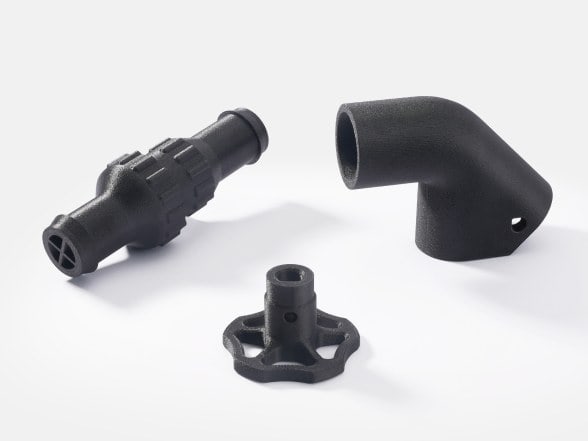
The rows are qualitative. Each one says "Resistant", "Not resistant", or a qualified version of those. No row gives a concentration, a temperature or a contact time, and no datasheet has a row for petrol, diesel or brake fluid. The nearest is "organic solvent".
So the table ranks materials; it does not clear a part for a chemical. Naming the chemical is what settles it. The quote form asks it ("Fuel, oils or solvents?"), and a person checks the material against the chemical, the temperature and how long it is wet.
The ranking
Rows quoted from each Bambu Lab datasheet. "Most popular" are the materials we print most; "ordered in" is sourced for the job.
| Material | Acid | Alkali | Organic solvent | Oil and grease | Status |
|---|---|---|---|---|---|
| PPS-CF | Resistant | Resistant | Resistant | Resistant | most popular |
| PPA-CF | Weak acids yes, strong no | Weak alkalis yes, strong no | Resistant to most | Resistant to most | most popular |
| ASA Aero | Resistant | Resistant | Not resistant to some | Resistant to most | most popular |
| ASA-CF | Resistant | Resistant | Not resistant to some | Resistant to most | ordered in |
| ASA | Resistant | Resistant | Not resistant to some | Not resistant to some | ordered in |
| PETG HF | Not resistant | Not resistant | Not resistant to some | Resistant to most | most popular |
| PET-CF | Not resistant | Not resistant | Not resistant to some | Resistant to most | most popular |
| PC FR | Not resistant | Not resistant | Not resistant to some | Resistant to most | most popular |
| PA6-CF | Not resistant | Not resistant | Not resistant to some | Resistant to most | ordered in |
| PAHT-CF | Not resistant | Not resistant | Not resistant to some | Resistant to most | ordered in |
| TPU for AMS | Not resistant | Not resistant | Not resistant to some | Resistant to most | most popular |
| PLA Basic | Not resistant | Not resistant | Not resistant to some | Resistant to most | most popular |
The PPA-CF datasheet words each row as "Better than general Nylon", then the qualifier shown. Bambu Lab's disclaimer applies to all of it: values are "for design reference and comparison only".
PPS-CF first
PPS-CF (PPS with carbon fibre) is the only material in the catalogue with "Resistant" on all four rows. Its datasheet also opens with "excellent resistance to solvents, corrosion, heat, and flames". It is on our most popular list, so it usually prints in 1-3 working days on average after you approve the price.
What it costs you: it is one of the dearer materials, and across the layers it keeps 24 MPa against 87 MPa along them (ISO 527, Z against X-Y). We orient the part to its load. For heat it also leads: 235 °C at 1.8 MPa (ISO 75).
PPA-CF second
PPA-CF answers "resistant to most" for solvents and for oil and grease. For acid and alkali it is resistant to weak ones and not to strong ones. If the part sees oil, grease or common solvents and also has to be stiff and strong, PPA-CF is the pick: 168 MPa tensile along the layers. Moisture is its weak side: 1.30% saturated water absorption against 0.05% for PPS-CF.
The ASA family
ASA, ASA-CF and ASA Aero resist acid and alkali, which most of the catalogue does not. They are not resistant to some organic solvents. Plain ASA is also "not resistant to some kinds of oil and grease". For cleaning agents and weak acids and alkalis, ASA is a reasonable pick; for solvents or oil, go up to PPA-CF or PPS-CF. Only ASA Aero is on our most popular list. ASA and ASA-CF are ordered in, so the quote gives their time.
Why PETG is not the answer
PETG HF's datasheet reads "Not resistant" to acid and to alkali, and "Not resistant to some organic solvents". PET-CF, PC FR, PA6-CF and PAHT-CF read the same. For a part that is only ever wiped with a damp cloth, PETG is fine. A part that sits in a cleaning bath or next to a solvent is not that.
Oil and grease is the easy row
Eleven of these twelve resist oil and grease: ten say "Resistant to most kinds of oil and grease", and PPS-CF says "Resistant". Only plain ASA does not. A gearbox cover or a sensor holder near machine oil does not need PPS-CF. A part that meets oil and a solvent, or oil and heat, does.
Tell us the chemical
Send the file and name the chemical: "Acetone", "hydraulic oil", "10% sodium hydroxide, wiped weekly". Add the temperature and how often it is wet. A person answers with a material, or says that none of ours fits. We print FDM plastic only; where a part needs a metal or a fluoropolymer, we say so.
Questions
Which filament is most chemical resistant?
PPS-CF: "Resistant" to acid, alkali, organic solvent, oil and grease in Bambu Lab's datasheet.
Is PETG chemical resistant?
Not to acid or alkali. The PETG HF datasheet reads "Not resistant" on both rows.
Can I print a fuel part in PPS-CF?
No datasheet has a fuel row, so we do not call any part suitable for fuel lines. Name the fuel and the conditions in the quote and a person checks.
Is a part food-safe?
We do not call any printed part food-safe. Food-contact grade filament is available on request, and the quote says what it changes.
Which chemical-resistant materials do you print fastest?
PPS-CF and PPA-CF, both on our most popular list: usually 1-3 working days on average. ASA, ASA-CF, PA6-CF and PAHT-CF are ordered in.
How big can the part be?
340 x 320 x 340 mm in PPS-CF and PPA-CF, the limit for carbon-fibre materials.

What will it touch?
Send the file and name the chemical. A person checks the material and replies with a price in 3 hours on average on workdays.