Which filament for a part that gets wet
Two questions get mixed up here. Does the plastic take up water, and does the printed part keep water out? Bambu Lab's datasheets answer the first for 15 filaments, ranked below. The second is about the part, not the plastic: we do not call any FDM part watertight.
- Ranked on saturated water absorption
- Lowest: PPS-CF, 0.05%
- 8 of the 15 on our most popular list
- Largest part 360 x 360 x 360 mm (340 x 320 x 340 mm in carbon-fibre and heated-chamber materials)
Two questions, kept apart
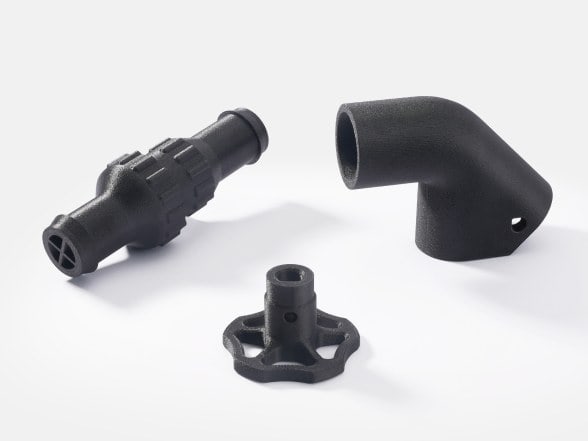
Water absorption is a property of the plastic. Bambu Lab measures it as saturated water absorption: how much water a test specimen takes up at saturation, in air at 25 °C and 55% relative humidity. It is not a figure for a part under water, and no datasheet here gives one.
Watertightness is a property of the part. An FDM part is built from lines and layers of plastic, and the joins between them can let water through even when the plastic itself takes up almost none. We do not call any printed part watertight or pressure-rated, and we do not call any part fit for food or drinking water.
So a low number in the table means the plastic takes up less water, and in a damp place the part changes size less. It does not mean the part seals.
15 filaments, ranked by water absorption
Every figure from Bambu Lab's datasheet for that material, lowest water absorption first. Water absorption is saturated, at 25 °C and 55% RH; heat deflection (HDT) by ISO 75 at 1.8 MPa, for the hot-water question below.
| Material | Water absorption | HDT at 1.8 MPa | Our status |
|---|---|---|---|
| 1. PPS-CF | 0.05% | 235 °C | most popular |
| 2. PC FR | 0.12% | 108 °C | most popular |
| 3. PC | 0.25% | 117 °C | ordered in |
| 4. PETG-CF | 0.30% | 68 °C | ordered in |
| 5. ASA-CF | 0.33% | 102 °C | ordered in |
| 6. PET-CF | 0.37% | 182 °C | most popular |
| 7. PETG HF | 0.40% | 62 °C | most popular |
| 8. PLA Basic | 0.43% | 54 °C | most popular |
| 9. ASA | 0.45% | 92 °C | ordered in |
| 10. ASA Aero | 0.80% | 78 °C | most popular |
| 11. PAHT-CF | 0.88% | 170 °C | ordered in |
| 12. TPU for AMS | 1.20% | not published | most popular |
| 13. PPA-CF | 1.30% | 196 °C | most popular |
| 14. PA6-CF | 2.35% | 164 °C | ordered in |
| 15. PA6-GF | 2.56% | 158 °C | ordered in |
The TPU for AMS datasheet records N/A for heat deflection, so we give no figure.
"Most popular" means the materials we print most; they usually take 1-3 working days on average after you approve the price. "Ordered in" materials are sourced for the job, and the quote gives the time.
Bambu Lab gives all its datasheet values "for design reference and comparison only". They are measured on test specimens, not on your part.
Low, middle and high
- Under 0.15%: PPS-CF and PC FRPPS-CF takes up 0.05%, less than anything else in the table, and PC FR 0.12%. Both are on our most popular list. PPS-CF is also the pick when the water is hot or carries a chemical; PC FR when the part must also be flame retardant.
- 0.25-0.45%: PC, PETG, PET-CF, PLA Basic, ASAPET-CF (0.37%), PETG HF (0.40%) and PLA Basic (0.43%) sit close together. For a part that is splashed, wiped or stands in damp air at room temperature, the gap between them is small; choose on heat, stiffness and price.
- 0.80% and up: ASA Aero, TPU and the nylonsASA Aero 0.80%, PAHT-CF 0.88%, TPU for AMS 1.20%, PPA-CF 1.30%, PA6-CF 2.35%, PA6-GF 2.56%. The nylons take up the most. PPA-CF is still the strongest material we print; for a wet place, weigh that against its 1.30%.
What the water does to a nylon
No datasheet here gives a strength or stiffness figure for a part that has taken up water, so we give none. What the datasheets do say: PA6-CF is meant for "structural parts used in dry environments", and PAHT-CF has been "optimized to retain excellent mechanical properties when wet".
If a nylon part will be wet, say so in the enquiry. A person weighs the strength you need against the water uptake; often PET-CF or PPS-CF is the better answer.
Hot water: heat deflection decides
Once the water is hot, water absorption is no longer the first question. Compare the water temperature with the HDT column. PLA Basic deflects at 54 °C and PETG HF at 62 °C under 1.8 MPa (ISO 75). For water near boiling, look only at materials above 100 °C. From our usual range those are PPS-CF (235 °C, 0.05%), PPA-CF (196 °C, 1.30%), PET-CF (182 °C, 0.37%) and PC FR (108 °C, 0.12%), which has little margin at 100 °C.
HDT is a short test on a specimen at one load, not a service temperature. Tell us the water temperature, how long the part sits in it and what load it carries, and a person checks. The full heat ranking is in the guide to filament for parts above 100 °C.
Water with something in it
Cleaning agents, acids, alkalis, oil and solvents are a chemical-resistance question, not a water one. Every Bambu Lab datasheet rates acid, alkali, organic solvent, and oil and grease; PPS-CF is the only material in the catalogue rated "Resistant" on all four. The chemical-resistance guide ranks 12 materials on those rows. Name the chemical when you ask for a quote.
When the part has to seal
A tank, a housing that must stay dry inside, a fitting under pressure: that is watertightness, and we do not promise it for an FDM part. Wall thickness, infill and the joins between layers all affect it, and no datasheet measures it.
If water must stay in or out, say so with the file. A person tells you before you pay whether FDM is the right process. Often a separate seal or gasket does the sealing and the printed part holds it in place. We print FDM only.
Questions
Which filament absorbs the least water?
PPS-CF: 0.05% saturated water absorption at 25 °C and 55% RH, in Bambu Lab's datasheet. PC FR is next at 0.12%. Both are on our most popular list.
Is a 3D printed part waterproof?
We do not call any FDM part watertight or waterproof. The plastic can resist water while the part still lets it through between the layers. If it has to seal, tell us and a person says whether FDM fits.
Is PETG water resistant?
PETG HF takes up 0.40% water at saturation, and its datasheet lists it as "Insoluble in water". It suits parts that get splashed or stand in damp air at room temperature. It deflects at 62 °C, so not for hot water.
Which filament for hot water?
One whose heat deflection temperature is well above the water temperature. From our usual range: PPS-CF (235 °C), PPA-CF (196 °C), PET-CF (182 °C) and PC FR (108 °C), at 1.8 MPa (ISO 75). Tell us the temperature and the load, and a person checks.
Can a printed part hold drinking water or touch food?
We do not call any printed part food-safe or fit for drinking water.
Do nylons get weaker when wet?
They take up the most water in the table, 0.88% to 2.56%. No datasheet here gives a wet strength figure, so we quote none; PA6-CF's datasheet places it in dry environments. Tell us the part will be wet and a person picks the material.

Where does it get wet?
Send the file and say how wet: damp air, splashes, washdown or hot water. A person picks the material and replies with a price in 3 hours on average on workdays.