Which filament for a part that gets hot
Here are nine Bambu Lab filaments with a heat deflection temperature above 100 °C, in order, with the test, the moisture figure and which ones we print from our usual range.
- Ranked on ISO 75 heat deflection
- 4 of the 9 are on our most popular list
- Hottest: PPS-CF, 235 °C at 1.8 MPa
- Up to 340 x 320 x 340 mm
Read the number first
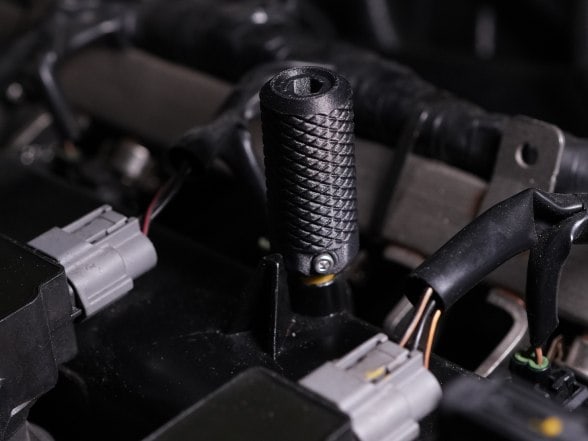
The figure everyone quotes is heat deflection temperature, HDT. It is the temperature at which a test bar bends by a set amount under a set load. ISO 75 runs it at two loads: 1.8 MPa (the harder test, the one we rank on) and 0.45 MPa.
What it is not: a service temperature. It is a short test on a specimen. It says nothing about months under load, and it says nothing about a part that carries more than 1.8 MPa. Bambu Lab gives all its datasheet values "for design reference and comparison only". Tell us the temperature and the load, and a person checks the part against them.
The ranking
Every figure from Bambu Lab's datasheet for that material, in order of heat deflection at 1.8 MPa. HDT by ISO 75; water absorption is saturated, at 25 °C and 55% RH.
| Material | HDT at 1.8 MPa | HDT at 0.45 MPa | Water absorption | Our status |
|---|---|---|---|---|
| 1. PPS-CF | 235 °C | 264 °C | 0.05% | most popular |
| 2. PPA-CF | 196 °C | 227 °C | 1.30% | most popular |
| 3. PET-CF | 182 °C | 205 °C | 0.37% | most popular |
| 4. PAHT-CF | 170 °C | 194 °C | 0.88% | ordered in |
| 5. PA6-CF | 164 °C | 186 °C | 2.35% | ordered in |
| 6. PA6-GF | 158 °C | 182 °C | 2.56% | ordered in |
| 7. PC | 117 °C | 112 °C* | 0.25% | ordered in |
| 8. PC FR | 108 °C | 113 °C | 0.12% | most popular |
| 9. ASA-CF | 102 °C | 110 °C | 0.33% | ordered in |
*The PC datasheet prints a lower figure at 0.45 MPa than at 1.8 MPa. We show it as printed.
For scale, the same test gives ASA 92 °C, ASA Aero 78 °C, PETG HF 62 °C and PLA Basic 54 °C.
"Most popular" means the materials we print most; they usually take 1-3 working days on average after you approve the price. "Ordered in" materials are sourced for the job, and the quote gives the time. All nine are heated-chamber materials, so the largest part in one piece is 340 x 320 x 340 mm.
The verdict, by temperature band
- 100-120 °C: PC FR, PC, ASA-CFPC FR is the one we print from our usual range, and it is the pick when the part also has to be flame retardant. At 108 °C it has little margin: a part at 100 °C is near its limit. If the brief is only "hot", go up a band.
- 120-200 °C: PET-CF, PPA-CF from our usual range; PAHT-CF, PA6-CF and PA6-GF ordered inPET-CF is the sensible default: 182 °C, 0.37% water, stiff (5,320 MPa bending modulus along the layers, ISO 178). PPA-CF is the strongest material we print, 168 MPa tensile along the layers (ISO 527), but it takes up 1.30% water. The other three nylons (PAHT-CF, PA6-CF, PA6-GF) take up 0.88% to 2.56%, so in a damp place they change size more than PET-CF or PPS-CF do.
- Above 200 °C: PPS-CF235 °C at 1.8 MPa, 264 °C at 0.45 MPa, 0.05% water. It is also the only material in the catalogue whose datasheet reads "Resistant" to acid, alkali, organic solvent and oil. If the part is hot and wet or hot and oily, it is this one.
What heat does that the table does not show
- Stiffness drops before the deflection pointHDT marks where a bar has bent by a fixed amount. A bracket that must not move at all needs more margin than the table suggests.
- Strength across the layers is lower for every one of thesePPS-CF keeps 24 MPa across the layers against 87 MPa along them; PPA-CF 57 against 168; PET-CF 35 against 74 (ISO 527, Z against X-Y). We orient the part so the load runs along the layers, and we need to know the load direction to do it.
- Moisture and heat togetherThe nylons' high water uptake matters most when the part is hot and wet.
Printing these
All nine need a heated chamber, and the carbon-fibre ones are abrasive. Bambu Lab specifies drying for eight of the nine. For you the two things that matter are the size limit, 340 x 320 x 340 mm, and a note on the load direction. Parts bigger than that are printed in sections and designed to be joined.
Questions
What is the highest-temperature filament you print?
PPS-CF: 235 °C heat deflection at 1.8 MPa and 264 °C at 0.45 MPa (ISO 75, Bambu Lab datasheet).
Can a PETG part go in a car?
Not near heat. PETG HF deflects at 62 °C under 1.8 MPa, so a part near the engine or a heater wants one of the nine above.
Is HDT the maximum use temperature?
No. It is a specimen test at one load. Treat it as a way to compare materials, and tell us the real temperature and load.
Which of these can you print fastest?
PPS-CF, PPA-CF, PET-CF and PC FR are on our most popular list, usually 1-3 working days on average after you approve. PAHT-CF, PA6-CF, PA6-GF, PC and ASA-CF are ordered in; the quote gives the time.
Is ASA hot enough?
Plain ASA deflects at 92 °C at 1.8 MPa, under the 100 °C line. ASA-CF reaches 102 °C and is ordered in.
Which one resists oil and fuel as well as heat?
PPS-CF: its datasheet reads "Resistant" to acid, alkali, organic solvent and oil. No datasheet has a fuel row, so name the fuel in the quote and a person checks.

What temperature does it see?
Send the file, the temperature and the load. A person picks the material and replies with a price in 3 hours on average on workdays.