Enclosures, from one to a batch
A box for a board, a sensor or a power supply, from a single prototype to a run. Pick the material by what the box faces: flame, heat, sun or knocks. Our tolerance is ±0.5%, minimum ±0.5 mm, so we say how to design the lid.
- 70 sensor enclosures for EDI, in two colours
- Flame-retardant PC FR on our most popular list
- From a single part
- Ships to the Baltics, Finland, Sweden and Denmark
Pick the material by what the box faces
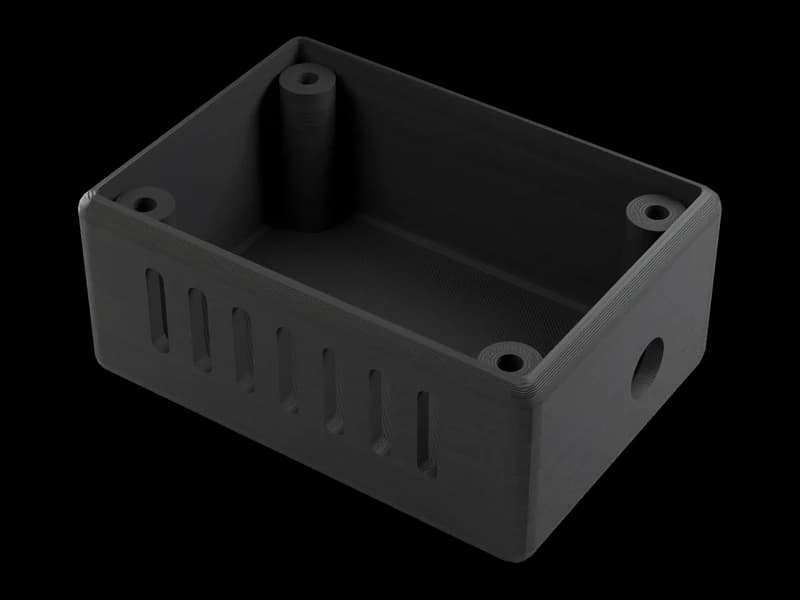
These cover most enclosures. Figures from Bambu Lab's datasheets, measured on test specimens, "for design reference and comparison only".
| PETG HF | PC FR | ASA Aero | PET-CF | |
|---|---|---|---|---|
| Use it when | indoors, no flame requirement, a quick job | the brief says flame retardant | outdoors, in sun | stiff, near warm electronics |
| Heat deflection, 1.8 MPa (ISO 75) | 62 °C | 108 °C | 78 °C | 182 °C |
| Impact strength X-Y / Z (ISO 179) | 31.5 / 10.6 kJ/m² | 55 / 8.0 kJ/m² | 32.0 / 3.4 kJ/m² | 36.0 / 4.5 kJ/m² |
| Saturated water absorption | 0.40% | 0.12% | 0.80% | 0.37% |
| Flame or UV note | none stated | UL 94 V-0 (Bambu Lab's test of the filament) | UV resistance stated | none stated |
| Our status | most popular | most popular | most popular | most popular |
| Largest part | 360 x 360 x 360 mm | 340 x 320 x 340 mm | 340 x 320 x 340 mm | 340 x 320 x 340 mm |
- PETG HFOur 24/7 WHITE PETG: the printers stay loaded with white, so there is no colour change to wait for or pay for. It is the default for a prototype enclosure.
- PC FRThe one for a flame-retardant housing. The V-0 is Bambu Lab's test of the filament, not a certificate for the printed box. It deflects at 108 °C, so it is not for a box next to a heater.
- ASA AeroCarries a UV statement in its datasheet. It is light (0.99 g/cm³) and weak across the layers.
- PET-CFPET with carbon fibre, and stiff: 5,320 MPa bending modulus along the layers (ISO 178). It leaves a matte black finish. For acid or alkali splashes it is not the one: its datasheet reads "Not resistant".
A printed enclosure comes with no IP rating, EMC performance, or CE or UL marking. Those tests are yours.
A real batch: 70 sensor enclosures for EDI
EDI, a research institute in Riga, needed 70 enclosures for sensor nodes. 30 in one colour and 40 in another, one of them matched to a RAL code. We proposed the closest filament colours, sourced the approved one, and printed all 70 in matte PETG as an express order.
One design, two colour variants, one deadline, and it went through the same route as a single part: file, price from a person, approval, print, parcel.
Design notes that survive a print
- Lids and fitsTolerance is ±0.5%, minimum ±0.5 mm. On a part under 100 mm that is ±0.5 mm. On a 200 mm base, ±1.0 mm. Two mating parts can differ by the sum. Draw the gap into the lid, and do not design a press fit that needs 0.1 mm.
- Fasteners over snapsPC FR stretches 2.4% before it breaks along the layers and 1.5% across them. A thin snap hook has little give. Screw bosses or a wide hook root hold up better.
- Layer directionEvery material above is weaker across the layers: PC FR 21 MPa against 60 MPa along them (ISO 527). Tell us where the screws pull and we orient the part to it.
- SizeOne piece up to 360 x 360 x 360 mm, or 340 x 320 x 340 mm in PC FR, ASA Aero and PET-CF. A larger enclosure is printed in sections designed to be joined.
Colour matching and finish
24/7 WHITE PETG is white. Another colour is an ordinary order: we load the colour for your job, which adds a setup charge and some time, and the quote shows both. If you need a specific colour, send the RAL code in the first email. We propose the closest filament colours and you approve one before the run.
FDM leaves layer lines, and carbon-fibre materials come off the printer matte black. A glossy, moulded finish is not what this process gives.
From prototype to first batch
- Order oneOne part is a real order. Check the fit with the board in it.
- Fix the fileChange the lid, the boss or the vent. Send the new STEP.
- Order the batchOne order carries one setup charge, so a run in one colour is one order. Two colours can go in one order too.
- Say the deadlineThe quote gives the date for your quantity. The figure "1-3 working days on average" is for the most popular materials.
What to send: the STEP files of each part (base, lid, any bracket), quantity, colour or RAL code, what the box faces, and the date you need it.
Questions
Can you print flame-retardant enclosures?
Yes, in PC FR. Its datasheet row reads "Flame retardant", and UL 94 V-0 is Bambu Lab's test of the filament. A finished box is not a certified part.
Does a printed enclosure have an IP rating?
No. We do not test or rate printed enclosures for IP, EMC, CE or UL.
Can you match a RAL colour?
We propose the closest filament colours and you approve one. EDI's enclosures were matched this way.
How many can you make?
From a single part upward. The EDI order was 70. The quote gives the date for your quantity.
Which material for a prototype box?
PETG HF, our 24/7 WHITE PETG: no colour change or setup to pay for. Another colour is an ordinary order, with a setup charge.
Can the enclosure go outdoors?
In ASA Aero, which states UV resistance in its datasheet. PETG HF's datasheet does not.

A box for your board?
Send the STEP files and say what the box faces. A person replies with a price in 3 hours on average on workdays.