3D printed prototypes, from one part
Test the idea in your hands, not only on a screen. Send a file, we print it, you test it, fix it and send the next version.
- From a single part, every version
- Usually 1-3 working days on popular materials
- A person checks every file
- Ships to the Baltics, Finland, Sweden and Denmark
Why print the prototype
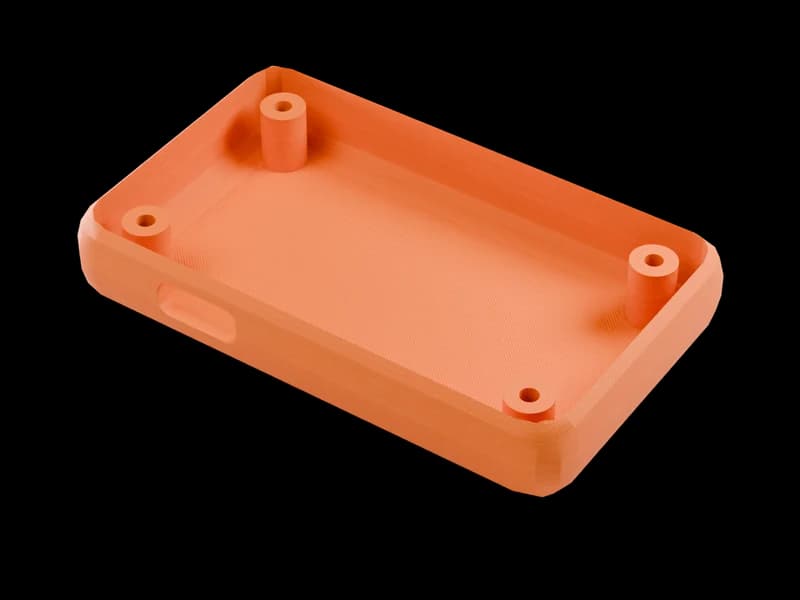
A prototype answers a question a screen cannot. Does the board go in, does the lid close, does the bracket bend? A mistake found in a printed part is cheap. The same mistake found in a mould or a first production batch is not.
FDM needs no mould and no tooling, so each version is only a new file. We print from a single part, so every version can be its own order.
Send, print, test, fix
One prototype loop. The shorter it is, the more versions you test before your deadline.
- SendA STEP, SLDPRT, STL or other file. A person checks it and replies with a price in 3 hours on average on workdays.
- We printThe most popular materials usually print in 1-3 working days on average after you approve. For anything else, the quote gives the time.
- TestScrew it together, fit it into the assembly, load it. Find what has to change.
- Fix and repeatSend the next version. One part is an order again.
Material by what the prototype tests
Almost anything works for a form check. A functional prototype needs the material the part will work in.
- Form and fitPLA Basic, PETG HF or our 24/7 WHITE PETG.
- Assembly and light loadPETG HF: screwing together, mounting, everyday handling.
- Large, light or outdoorsASA Aero, a foamed ASA that is light and UV resistant.
- Load, heat or oilPPA-CF, PPS-CF or PET-CF, the carbon-fibre filaments.
- Soft and flexibleTPU for AMS, for seals and grips.
Say what the prototype has to prove, and a person suggests the material.
What to put in the request
The more we know about the prototype's job, the better the material and the print orientation we suggest.
- What it testsForm, assembly, load, heat or outdoor use.
- What must fitThe sizes that meet other parts, such as screw holes and joints.
- How manyHow many of each version you need.
- Your deadlineIf it is urgent, the first reply says whether it can be met.
Files, sizes and tolerance
We open STEP, STP, STL, 3MF, OBJ and SLDPRT. For a prototype, send STEP or SLDPRT if you have CAD: they keep the exact geometry. No file yet? Photos with measurements or a sketch work too; we draw the model and you approve it before it prints.
- Largest part360 x 360 x 360 mm in one piece; carbon-fibre and heated-chamber filaments 340 x 320 x 340 mm. Bigger parts are printed in sections, designed to be joined.
- Tolerance±0.5% of the size, minimum ±0.5 mm. Mark the dimensions that must fit another part.
When the prototype is right, the same part can be printed as a small batch. Order preparation is done once per order, so each part costs less in a batch.
When FDM is the wrong answer
- A smooth, glossy surfaceFDM leaves layer lines. A prototype that has to look moulded needs sanding and paint.
- A fit tighter than ±0.5 mmBearing seats and press fits to a fraction of a millimetre are outside what FDM holds.
- Metal or resinWe print FDM plastic only.
A person says so before you pay.
Questions
Do you print a single prototype?
Yes. There is no minimum quantity: one part is an order, and so is each next version.
How fast do I get a prototype?
The most popular materials usually print in 1-3 working days on average after you approve. Anything else is ordered in, and the quote gives the time. The carrier and the transit time are in the quote too.
Do you take SolidWorks files?
Yes, SLDPRT, as well as STEP, STP, STL, 3MF and OBJ.
Which material for a functional prototype?
PETG HF for everyday tests, ASA Aero for light and outdoor parts, PPA-CF, PPS-CF or PET-CF for load and heat. Say what the prototype tests and a person suggests one.
How accurate is the prototype?
±0.5% of the size, never tighter than ±0.5 mm. Mark the dimensions that must fit another part.
Where do you ship?
To the Baltics, Finland, Sweden and Denmark, to a parcel locker or an address.

Send the first version
A STEP, SLDPRT or STL file and a line on what the prototype tests. A person replies with the material, the price and the lead time.