Filament heat resistance chart: three numbers, and which to read
Heat deflection at 1.8 MPa (ISO 75) on Bambu Lab's datasheets: PETG HF 62 °C, PLA Basic 54 °C, ASA 92 °C, PC FR 108 °C, PPS-CF 235 °C. It is a short test on a specimen, not a working temperature. The chart below puts that figure next to the two others a datasheet gives, Vicat softening and glass transition, for every grade we print or order in, and says which one to read for a part that gets warm.
- PETG HF: heat deflection 62 °C at 1.8 MPa, Vicat 70 °C, glass transition 66 °C
- PPS-CF: 235 °C at 1.8 MPa, the top of the chart
- TPU: "N/A" for heat deflection, Vicat and glass transition
- PETG HF, PC FR, PPS-CF 2-5 working days after payment
How much heat can each filament take?
Read heat deflection at 1.8 MPa first: it is the only one of the three numbers measured on a bar carrying a load. On it, PLA Basic is 54 °C and PETG HF, our 24/7 PETG, 62 °C. Above those: ASA Aero 78 °C, ASA 92 °C, PC FR 108 °C, the carbon-fibre nylons and PET-CF 164 to 196 °C, PPS-CF 235 °C.
None of the three is a service temperature: tell us where the part sits and what it carries.
Three numbers, three tests
- Heat deflection temperature (ISO 75)A test bar under a set bending load is heated until it bends by a set amount; that temperature is the figure. Bambu Lab gives it at two loads, 1.8 MPa and 0.45 MPa, and the heavier load gives the lower figure on every datasheet except PC's.
- Vicat softening temperature (ISO 306)A test-machine maker, ZwickRoell, defines it as "the temperature at which a defined indenter penetrates exactly 1 mm deep under a defined load and heating rate". A needle into the surface, not a bar bending. Bambu Lab's row names the standard and no load, so we quote the figure and nothing more.
- Glass transition temperature (DSC, 10 °C/min)Where the polymer changes from glassy to rubbery, measured on the material with no load on it. It is not a heat limit, and the chart shows why.
The chart
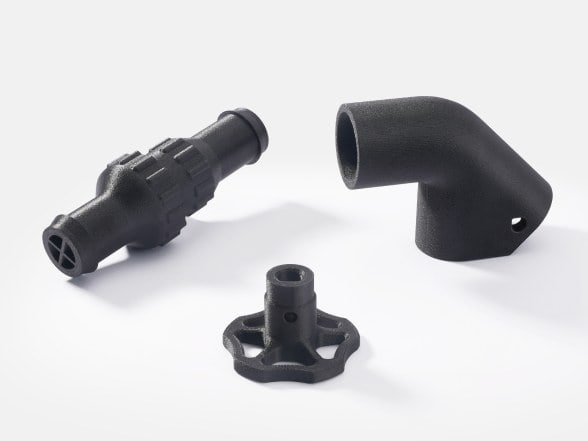
Every grade we print or order in, ranked on heat deflection at 1.8 MPa. Figures are Bambu Lab's datasheet values for printed specimens, given "for design reference and comparison only". "N/A" is what the datasheet prints; "not given" means the datasheet has no row, or prints a slash. Heat deflection and Vicat in °C.
| Heat deflection 1.8 MPa (ISO 75) | Heat deflection 0.45 MPa (ISO 75) | Vicat (ISO 306) | Glass transition (DSC) | Our status | |
|---|---|---|---|---|---|
| 1. PPS-CF | Heat deflection 1.8 MPa (ISO 75)235 °C | Heat deflection 0.45 MPa (ISO 75)264 °C | Vicat (ISO 306)268 °C | Glass transition (DSC)100 °C | Our statusmost popular |
| 2. PPA-CF | Heat deflection 1.8 MPa (ISO 75)196 °C | Heat deflection 0.45 MPa (ISO 75)227 °C | Vicat (ISO 306)232 °C | Glass transition (DSC)85 °C | Our statusmost popular |
| 3. PET-CF | Heat deflection 1.8 MPa (ISO 75)182 °C | Heat deflection 0.45 MPa (ISO 75)205 °C | Vicat (ISO 306)226 °C | Glass transition (DSC)75 °C | Our statusmost popular |
| 4. PAHT-CF | Heat deflection 1.8 MPa (ISO 75)170 °C | Heat deflection 0.45 MPa (ISO 75)194 °C | Vicat (ISO 306)220 °C | Glass transition (DSC)70 °C | Our statusordered in |
| 5. PA6-CF | Heat deflection 1.8 MPa (ISO 75)164 °C | Heat deflection 0.45 MPa (ISO 75)186 °C | Vicat (ISO 306)212 °C | Glass transition (DSC)68 °C | Our statusordered in |
| 6. PA6-GF | Heat deflection 1.8 MPa (ISO 75)158 °C | Heat deflection 0.45 MPa (ISO 75)182 °C | Vicat (ISO 306)210 °C | Glass transition (DSC)67 °C | Our statusordered in |
| 7. PC | Heat deflection 1.8 MPa (ISO 75)117 °C | Heat deflection 0.45 MPa (ISO 75)112 °C* | Vicat (ISO 306)119 °C | Glass transition (DSC)145 °C | Our statusordered in |
| 8. PC FR | Heat deflection 1.8 MPa (ISO 75)108 °C | Heat deflection 0.45 MPa (ISO 75)113 °C | Vicat (ISO 306)114 °C | Glass transition (DSC)145 °C | Our statusmost popular |
| 9. ASA-CF | Heat deflection 1.8 MPa (ISO 75)102 °C | Heat deflection 0.45 MPa (ISO 75)110 °C | Vicat (ISO 306)108 °C | Glass transition (DSC)not given | Our statusordered in |
| 10. ASA | Heat deflection 1.8 MPa (ISO 75)92 °C | Heat deflection 0.45 MPa (ISO 75)100 °C | Vicat (ISO 306)106 °C | Glass transition (DSC)N/A | Our statusordered in |
| 11. ABS-GF | Heat deflection 1.8 MPa (ISO 75)88 °C | Heat deflection 0.45 MPa (ISO 75)99 °C | Vicat (ISO 306)103 °C | Glass transition (DSC)N/A | Our statusask |
| 12. ABS | Heat deflection 1.8 MPa (ISO 75)84 °C | Heat deflection 0.45 MPa (ISO 75)87 °C | Vicat (ISO 306)94 °C | Glass transition (DSC)N/A | Our statusordered in |
| 13. ASA Aero | Heat deflection 1.8 MPa (ISO 75)78 °C | Heat deflection 0.45 MPa (ISO 75)85 °C | Vicat (ISO 306)80 °C | Glass transition (DSC)N/A | Our statusmost popular |
| 14. PETG-CF | Heat deflection 1.8 MPa (ISO 75)68 °C | Heat deflection 0.45 MPa (ISO 75)74 °C | Vicat (ISO 306)85 °C | Glass transition (DSC)68 °C | Our statusordered in |
| 15. PETG HF | Heat deflection 1.8 MPa (ISO 75)62 °C | Heat deflection 0.45 MPa (ISO 75)69 °C | Vicat (ISO 306)70 °C | Glass transition (DSC)66 °C | Our statusmost popular |
| 16. PLA Pure | Heat deflection 1.8 MPa (ISO 75)56 °C | Heat deflection 0.45 MPa (ISO 75)60 °C | Vicat (ISO 306)not given | Glass transition (DSC)not given | Our statusordered in |
| 17. PLA Basic | Heat deflection 1.8 MPa (ISO 75)54 °C | Heat deflection 0.45 MPa (ISO 75)57 °C | Vicat (ISO 306)57 °C | Glass transition (DSC)60 °C | Our statusmost popular |
| 17. PLA-CF | Heat deflection 1.8 MPa (ISO 75)54 °C | Heat deflection 0.45 MPa (ISO 75)55 °C | Vicat (ISO 306)69 °C | Glass transition (DSC)63 °C | Our statusordered in |
| TPU for AMS | Heat deflection 1.8 MPa (ISO 75)N/A | Heat deflection 0.45 MPa (ISO 75)N/A | Vicat (ISO 306)N/A | Glass transition (DSC)N/A | Our statusmost popular |
| TPU 95A HF, TPU 90A, TPU 85A | Heat deflection 1.8 MPa (ISO 75)N/A | Heat deflection 0.45 MPa (ISO 75)N/A | Vicat (ISO 306)N/A | Glass transition (DSC)N/A | Our statusordered in |
*PC is the one datasheet with a lower figure at 0.45 MPa than at 1.8 MPa; it is shown as printed. ASA-CF's glass transition cell prints a slash, so it reads "not given" here; PLA Pure's file has no Vicat or glass transition row.
What is given: heat deflection for 18 grades, Vicat for 17, glass transition for 12, and nothing in these columns for the four TPU grades.
Which number to read
Heat deflection at 1.8 MPa, first and usually only. It is the one measured on a loaded bar, it is the one given for most grades, and it is the harder of the two loads. The 0.45 MPa figure is the same test with a quarter of the load; read it for a part that only has to hold its shape.
Vicat adds little for a loaded part. Where both are given, Vicat sits at or above the 0.45 MPa heat deflection for 15 of 17 grades, the two exceptions being ASA-CF, 108 against 110 °C, and ASA Aero, 80 against 85 °C, and it is above the 1.8 MPa figure for all 17. A chart ranked on Vicat would put all 17 above their heat deflection at 1.8 MPa.
Glass transition is the number the ranking pages quote and the one to read last, for the reason in the next section.
Why glass transition misleads
Six datasheets list a crystallization temperature: PPS-CF 214 °C, PA6-CF 185 °C, PA6-GF 183 °C, PPA-CF 178 °C, PAHT-CF 140 °C and PET-CF 130 °C (DSC). They are the six highest on heat deflection, and each deflects 91 to 135 °C above its own glass transition: PPS-CF 235 against 100 °C, PA6-GF 158 against 67 °C. The crystalline, fibre-filled grades hold their shape above their glass transition, which is what the heat deflection test measures.
For PC and PC FR, whose crystallization row prints "N/A", it is the reverse. Their glass transition is 145 °C and their heat deflection at 1.8 MPa is 117 and 108 °C, 28 to 37 °C lower. A chart ranked by glass transition would put polycarbonate above every carbon-fibre nylon; ranked by heat deflection it sits below all six.
For PETG HF and PLA Basic the numbers sit together: heat deflection 62 and 69 °C, Vicat 70 °C and glass transition 66 °C for PETG HF; 54, 57, 57 and 60 °C for PLA Basic. There the choice of number barely matters. Where it matters, glass transition is wrong in both directions, in the same catalogue.
What temperature can PETG, PLA and ASA take
Each figure is heat deflection at 1.8 MPa (ISO 75), a specimen test, not a service temperature; it is the number we read against the place you describe. PLA Basic 54 °C. PLA Pure 56 °C. PETG HF 62 °C, and PETG HF in white is 24/7 PETG. PETG-CF 68 °C. ASA Aero 78 °C. ABS 84 °C, ordered in. ASA 92 °C. ASA-CF 102 °C. PC FR 108 °C. The carbon-fibre nylons and PET-CF 164 to 196 °C. PPS-CF 235 °C. TPU: no figure.
The buyers who write to us describe places, not degrees: a bracket by a power supply running around the clock, a clip on a fuel rail. For a part that gets warm, on a sunny windowsill or next to electronics running all day, we look for a heat deflection of at least 60 °C, which PETG HF clears and PLA Basic does not; the hottest part in our enquiry archive sat indoors next to a power supply running 24/7 and went to PETG. For a part that is genuinely hot, by a radiator, in hot water or inside enclosed machinery, at least 100 °C, which ASA-CF, PC FR, PC and every grade above them clear. For a fuel-rail clip the answer was PPA-CF or PPS-CF.
No figure for TPU
All four TPU datasheets print "N/A" for heat deflection at both loads, for Vicat and for glass transition. Bambu Lab publishes no heat figure for them that a part can be checked against, and we do not invent one. A flexible part near a motor or a heater is a part you test; we say so before the price.
Hotter than 100 °C
For a part that is hot rather than warm, the nine grades above 100 °C are ranked with their water absorption and what each is for on Filament for parts above 100 °C; this chart adds the Vicat and glass transition columns and the grades below 100 °C. Hot water and steam have their own page, Filament for wet and humid parts.
Tell us where the part sits
Our quote form asks about heat, load, priority and chemicals. Write the place in the message: "next to a 24/7 power supply", "in a boiler room", "on a windowsill". A person reads the chart against it and picks the grade before the price, and says when FDM is the wrong answer.
- PETG HF, PC FR, PPS-CF, PPA-CF, PET-CF, ASA Aero and PLA Basic: among our most popular materials, usually 2-5 working days after payment.
- ASA, ASA-CF, PC, PETG-CF, PLA Pure, PLA-CF and the nylons ordered in: the quote gives the time. Ask for two grades in one request and the quote prices each.
- Largest part in one piece: 340 x 320 x 340 mm in every material. Tolerance ±0.5%, minimum ±0.5 mm.
- Posted to the Baltics, Finland, Sweden and Denmark. Reply with a price in 3 hours on average on workdays.
Questions
Checked by the druckworks workshopUpdated
What temperature can PETG withstand?
On Bambu Lab's PETG HF datasheet: heat deflection 62 °C at 1.8 MPa and 69 °C at 0.45 MPa (ISO 75), Vicat 70 °C (ISO 306), glass transition 66 °C (DSC). A specimen test, not a service temperature; for a part that gets warm we look for at least 60 °C, which PETG HF clears.
What is the difference between heat deflection and Vicat?
Heat deflection bends a loaded bar; Vicat pushes a needle 1 mm into the surface. Where Bambu Lab gives both, Vicat sits at or above the light-load heat deflection for 15 of 17 grades and above the 1.8 MPa figure for all 17. Read heat deflection at 1.8 MPa for a loaded part.
Is glass transition the maximum temperature?
No, in either direction. PPS-CF's glass transition is 100 °C and its heat deflection 235 °C; PC FR's glass transition is 145 °C and its heat deflection 108 °C. Read heat deflection, not glass transition.
What is the most heat-resistant filament?
Of the grades we print or order in, PPS-CF: 235 °C at 1.8 MPa and 264 °C at 0.45 MPa (ISO 75), Vicat 268 °C. It is on our most popular list. The ranking above 100 °C is on Filament for parts above 100 °C.
Does TPU handle heat?
No datasheet says. All four TPU grades print "N/A" for heat deflection, Vicat and glass transition, so we give no limit. Tell us the temperature and a person says whether to test it or pick another material.
Is the Bambu Lab PLA glass transition 60 °C?
Yes: 60 °C by DSC at 10 °C/min on the PLA Basic datasheet (TDS V3.0), with heat deflection 54 °C at 1.8 MPa and 57 °C at 0.45 MPa and Vicat 57 °C.
How big can a heat-resistant part be?
340 x 320 x 340 mm in every material.

Tell us where the part sits
Send the file and write the place and the load: "by a 24/7 power supply", "on a 90 °C pipe". A person reads the chart against it and replies with a price in 3 hours on average on workdays.