PETG or PLA for a part that has to work
At room temperature the two are closer than the internet says: on Bambu Lab's datasheets PLA Basic matches PETG HF in tensile strength and is stiffer. The row that decides a functional part is heat. PETG HF deflects at 62 °C under load, PLA Basic at 54 °C, and most working parts live nearer to warmth than you think.
- Heat deflection at 1.8 MPa: PLA Basic 54 °C, PETG HF 62 °C (ISO 75)
- Tensile strength along the layers: 35 against 34 MPa, a tie (ISO 527)
- Both 2-5 working days after payment; white PETG runs around the clock
- Up to 340 x 320 x 340 mm in one piece in either
Is PETG or PLA better for a functional part?
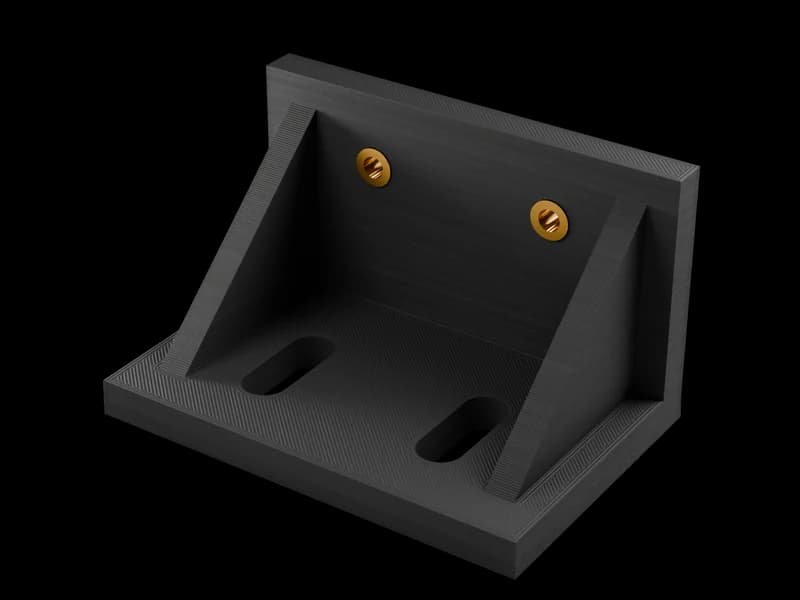
Choose PETG HF for any part that works near warmth: a bracket by a window, a mount on running electronics, anything that rides in a car. That is most functional parts. White PETG is the one our printers run around the clock, so it is also usually the quickest.
Choose PLA Basic for a part that stays indoors and cool and must be stiff or look sharp: a jig on a bench, a display model, a prototype to be measured.
The two side by side
Figures from Bambu Lab's datasheets for PLA Basic (TDS V3.0) and PETG HF (TDS V1.0), measured on test specimens and given "for design reference and comparison only". X-Y is along the layers, Z across them. Both specimen sets were annealed and dried before testing (PLA Basic at 55 °C for 8 h, PETG HF at 75 °C for 8 h), so the comparison is fair on paper.
| PLA Basic | PETG HF | |
|---|---|---|
| Our status | PLA Basicmost popular | PETG HFmost popular; white is 24/7 PETG |
| Heat deflection at 1.8 / 0.45 MPa (ISO 75) | PLA Basic54 / 57 °C | PETG HF62 / 69 °C |
| Vicat softening temperature (ISO 306) | PLA Basic57 °C | PETG HF70 °C |
| Tensile strength X-Y / Z (ISO 527) | PLA Basic35 / 31 MPa | PETG HF34 / 23 MPa |
| Bending modulus X-Y / Z (ISO 178) | PLA Basic2,750 / 2,370 MPa | PETG HF2,050 / 1,810 MPa |
| Impact strength X-Y, unnotched (ISO 179) | PLA Basic26.6 kJ/m² | PETG HF31.5 kJ/m² |
| Impact strength Z (ISO 179) | PLA Basic13.8 kJ/m² | PETG HF10.6 kJ/m² |
| Elongation at break X-Y (ISO 527) | PLA Basic12.2% | PETG HF8.6% |
| UV (store page; both datasheets silent) | PLA Basic"Low UV resistance" listed as a con | PETG HF"Water & UV Resistant" listed as a pro |
| Largest part in one piece | PLA Basic340 x 320 x 340 mm | PETG HF340 x 320 x 340 mm |
Rows that do not differ are left out. Saturated water absorption is 0.43% for PLA Basic and 0.40% for PETG HF. The chemical rows are identical: both "Not resistant" to acid and alkali, "Not resistant to some organic solvents", "Resistant to most kinds of oil and grease". Density is 1.24 against 1.28 g/cm³.
Read heat deflection as a loaded specimen test, not as the temperature a part can work at. A real part with thin walls and a load on it gives up earlier than the specimen did.
What the datasheets change
Along the layers, strength is a tie: PLA Basic pulls 35 MPa and PETG HF 34 MPa. Across the layers PLA Basic keeps more, 31 against 23 MPa. PLA Basic is stiffer too, 2,750 against 2,050 MPa bending modulus along the layers. So "PETG is stronger than PLA" is not what these two datasheets say. Bambu Lab's own words pull both ways: PETG HF offers "greater durability and toughness than PLA", and PLA Basic has "excellent toughness and Z-layer strength". Each figure above says which statement it supports.
Toughness is split. PETG HF takes the harder unnotched knock along the layers (31.5 against 26.6 kJ/m²), PLA Basic the harder knock across them (13.8 against 10.6 kJ/m²), and PLA Basic stretches further before it breaks (12.2 against 8.6%). "PLA is brittle" is also not what these two datasheets say.
Heat is not a tie. 62 °C against 54 °C at 1.8 MPa, 70 °C against 57 °C Vicat. For a part that gets warm, on a sunny windowsill, in a parked car or next to electronics that run all day, we look for a heat deflection of at least 60 °C: PETG HF clears it, PLA Basic does not. That is the row we decide on when a part has a job.
Choose PETG HF when
- the part sits near warmth: a window, a radiator, a power supply, a lamp, a car
- it is a mount, bracket, clip, housing or guide that works every day
- it gets damp or washed: both resist water, and PETG HF's store page also lists UV resistance
- you want it fast and white: 24/7 PETG has no setup to wait for or pay for
One heat case in our enquiries sat indoors: a wall mount for a power supply that runs 24 hours a day. It went to PETG, because indoors is not the same as cool. When we pick by hand, the rule is one line: looks go to PLA, a mix of looks and strength to PETG, strength to carbon fibre.
Choose PLA Basic when
- the part stays indoors and cool: a bench jig, a drawer organiser, a gauge, a display model
- stiffness matters more than warmth: 2,750 MPa bending modulus, the stiffer of the two
- the surface and the detail matter: Bambu Lab names dimensional accuracy among PLA's strengths
- the prototype's job is to be measured, held and looked at, not to work in the machine
PLA Basic is one of our most popular materials: 2-5 working days after payment. It is an ordinary order with the usual setup charge.
Neither, when
- Above 62 °CA part near an engine, a heater or a motor is past PETG HF. A carbon fibre material takes it: see PETG or PET-CF for stiff parts, or PPA-CF for heat deflection at 196 °C.
- Months of direct sunNeither datasheet states UV resistance; only PETG HF's store page ticks it. For a part in permanent sun we point to ASA or ASA Aero, whose datasheets state it: see PETG or ASA for outdoor parts.
- A real load on a thin wallBefore you move to carbon fibre, send the design. For a loaded part we add walls, and we choose the print orientation: PETG HF holds 34 MPa along the layers and 23 MPa across them (ISO 527), so say which way the load runs.
What we print most
PETG HF and PLA Basic are both on our most popular list: usually 2-5 working days after payment. White PETG HF is 24/7 PETG, which our printers run around the clock, so there is no setup to wait for or pay for. Any other colour of PETG, and every PLA order, is an ordinary order with the usual setup charge.
A part in either is up to 340 x 320 x 340 mm in one piece. Tolerance ±0.5%, minimum ±0.5 mm. Parts are posted to the Baltics, Finland, Sweden and Denmark. Ask for both materials in one request and the quote prices each.
Questions
Checked by the druckworks workshopUpdated
Is PETG stronger than PLA?
Not on these two datasheets. Along the layers it is 34 against 35 MPa; across them PLA Basic keeps 31 MPa and PETG HF 23 MPa (ISO 527). PETG HF takes a harder unnotched knock along the layers; PLA Basic takes a harder one across them. The real difference is heat: 62 against 54 °C heat deflection at 1.8 MPa.
Will PLA soften in a parked car?
PLA Basic deflects under load at 54 °C and softens at 57 °C (Vicat, ISO 306). A closed car in summer sun can reach that, so we do not put PLA in a car. PETG HF has 62 °C, which is better but not generous; say where in the car the part sits and a person decides, and for anything near the engine we quote a carbon fibre material.
Is PETG UV resistant?
Bambu Lab's PETG HF datasheet does not say; its store page ticks it. PLA Basic's store page lists low UV resistance as a con. For a part in permanent sun we point to ASA, whose datasheet states UV resistance.
Is PETG chemical resistant?
Not by its datasheet: "Not resistant" to acid and alkali, "Not resistant to some organic solvents". It does resist water and most oils and greases, and so does PLA Basic. For chemicals, see Chemical-resistant filament.
Which is cheaper?
24/7 PETG carries no setup to wait for or pay for. PLA Basic is an ordinary order with the usual setup charge. The quote shows the price of each for your part.
Can I have PETG in another colour?
Yes. Any colour other than white is an ordinary PETG HF order with the usual setup charge, and the quote gives the time. White is the one with no setup.
Is PLA strong enough for a shelf bracket?
Indoors and cool, often: it is as strong as PETG HF along the layers and stiffer. The risk is a bracket by a window or a radiator, where 54 °C is reached sooner than you expect. Send the file and say where the bracket goes, and a person picks the material and the orientation.
Do you post PETG and PLA parts to Finland?
Yes. We post to Latvia, Estonia, Lithuania, Finland, Sweden and Denmark. The quote names the carrier and the shipping price.

A part that has a job to do?
Send the file and say where the part sits and how warm it gets. A person picks PETG HF or PLA Basic, or says when neither will do, and replies with a price in 3 hours on average on workdays.