Flame-retardant filament: two datasheets say so
Among the Bambu Lab grades we print or order in, two datasheets call the filament flame retardant, and both are on our most popular list. PC FR when a drawing asks for a flame class: UL 94 V-0 is Bambu Lab's test of the filament. PPS-CF when the part must also take heat or chemicals: its row reads "Self-extinguishing when away from fire; flame-retardant" and Bambu Lab publishes no UL class for it. Every other row, PETG, PLA, ASA, the nylons and the TPUs, reads "Flammable". A printed part carries no rating of its own.
- PC FR: "Flame retardant"; UL 94 V-0 is Bambu Lab's test of the filament
- PPS-CF: "Self-extinguishing when away from fire; flame-retardant"
- PC FR and PPS-CF 2-5 working days after payment
- Up to 340 x 320 x 340 mm in one piece
Which filament is flame retardant?
Two grades say so on their datasheets. PC FR when the drawing names a flame class or the part is a housing: Bambu Lab states that it tested the filament to UL 94 V-0. PPS-CF when the part must also be hot, stiff or in contact with solvents: its row reads "Self-extinguishing when away from fire; flame-retardant", with no UL class published.
Everything else we print or order in reads "Flammable", PETG HF included. The class belongs to the filament, not to the part; we certify no part.
The flammability row, grade by grade
Every Bambu Lab datasheet we print from has one row called Flammability. Here is what it says for each grade in our catalogue, quoted as printed, with our status. The 20 grades that read "Flammable" are not ranked against each other: the datasheets give no figure to rank them by.
| Datasheet row | Grades | Our status | |
|---|---|---|---|
| Flame retardant, with a class | Datasheet row"Flame retardant"; Bambu Lab's product page adds "Tested to meet the UL 94-2023 V-0 standard" | GradesPC FR | Our statusmost popular |
| Flame retardant, no class | Datasheet row"Self-extinguishing when away from fire; flame-retardant" | GradesPPS-CF | Our statusmost popular |
| Flammable | Datasheet row"Flammable" | GradesPLA Basic, PETG HF, TPU for AMS, PPA-CF, PET-CF, ASA Aero | Our statusmost popular |
| Flammable | Datasheet row"Flammable" | GradesASA, ASA-CF, PA6-CF, PA6-GF, PAHT-CF, PC, PETG-CF, PLA-CF, PLA Pure, TPU 95A HF, TPU 90A, TPU 85A | Our statusordered in |
| Flammable | Datasheet row"Flammable" | GradesABS, ABS-GF | Our statusABS ordered in; ABS-GF: ask |
The count: 2 rows say flame retardant, 20 say "Flammable". PPS-CF's Basic Info adds "excellent resistance to solvents, corrosion, heat, and flames"; that is Bambu Lab's description, not a class. Plain PC reads "Flammable" like the rest, so "polycarbonate" alone does not mean flame retardant.
PC FR or PPS-CF
Both from Bambu Lab's datasheets (both TDS V1.0), measured on printed specimens and given "for design reference and comparison only". X-Y is along the layers, Z across them.
| PC FR | PPS-CF | |
|---|---|---|
| Flammability row | PC FR"Flame retardant" | PPS-CF"Self-extinguishing when away from fire; flame-retardant" |
| Flame class | PC FRUL 94 V-0, Bambu Lab's test of the filament | PPS-CFnone published by Bambu Lab |
| Heat deflection, 1.8 MPa (ISO 75) | PC FR108 °C | PPS-CF235 °C |
| Acid, alkali, organic solvent, oil (datasheet rows) | PC FR"Not resistant", "Not resistant", "Not resistant to some organic solvents", "Resistant to most kinds of oil and grease" | PPS-CF"Resistant" on all four |
| Saturated water absorption (25 °C, 55% RH) | PC FR0.12% | PPS-CF0.05% |
| Tensile strength, X-Y / Z (ISO 527) | PC FR60 / 21 MPa | PPS-CF87 / 24 MPa |
| Impact strength, X-Y / Z (ISO 179, unnotched) | PC FR55 / 8.0 kJ/m² | PPS-CF27.8 / 2.8 kJ/m² |
| Elongation at break, X-Y (ISO 527) | PC FR2.4% | PPS-CF1.2% |
| Bending modulus, X-Y (ISO 178) | PC FR1,890 MPa | PPS-CF7,160 MPa |
| Largest part in one piece | PC FR340 x 320 x 340 mm | PPS-CF340 x 320 x 340 mm |
Reading it: PC FR is the one with a class to point to, and the tougher one, 55 against 27.8 kJ/m² along the layers and 8.0 against 2.8 across them. A housing, a cover, a battery box, a bracket that gets knocked: PC FR. PPS-CF is the one when the part must also take more heat (heat deflection 235 against 108 °C), or be stiff, or sit in solvent, and the drawing does not name a class. It is brittle: 2.8 kJ/m² across its layers and 1.2% elongation at break even along them, so a PPS-CF part is designed and oriented for that. Ask for both in one request and the quote prices each.
A class belongs to a thickness
UL 94 is Underwriters Laboratories' flammability test for plastics; the summary that follows is from its Wikipedia article, not from Bambu Lab or from us. V-0: "burning stops within 10 seconds on a vertical specimen; drips of particles allowed as long as they are not inflamed". V-1 and V-2: burning stops "within 30 seconds". HB: "slow burning on a horizontal specimen". And the sentence that matters for a printed part: "Tests are generally conducted on a 5 × 1⁄2 in (127 × 12.7 mm) specimen of the minimum approved thickness."
So a class is a material at a thickness. Bambu Lab's statement for PC FR gives no thickness in anything we hold: not its datasheet, whose row reads "Flame retardant", and not the product page sentence. Your printed wall has its own thickness, its own infill and its own layer bonds, none of which a filament test saw. The class is the filament's; the box is untested until someone tests the box. PC FR and UL 94 V-0: what it covers is on the PC FR page, in one paragraph.
A flame class for your finished product comes only from testing the printed part, and that test is yours to run; we print the test pieces and the production part, and we certify no part. Building, rail and vehicle fire classes are outside what we can speak to at all.
Flame is not heat
Search engines send "fire resistant filament" straight to "heat resistant filament", and the two are different rows. Heat deflection is a loaded specimen bending under warmth: PC FR 108 °C, PPS-CF 235 °C at 1.8 MPa (ISO 75). Flammability is what the material does in a flame. PPS-CF leads on heat by a wide margin and has no flame class; PC FR has the class and sits in the middle of the heat ranking. Neither word on either datasheet means fireproof: PPS-CF's own row says it stops burning "when away from fire".
For a part that is hot rather than exposed to flame, the ranking of every grade on heat deflection is on Filament for parts above 100 °C.
Is there a flame-retardant PETG, PLA or ABS?
Not in the range we print from. Bambu Lab's PETG HF, PETG-CF, PLA Basic, PLA Pure, PLA-CF, ABS and ABS-GF datasheets all read "Flammable", and so does PETG HF as our 24/7 PETG. Other makers sell flame-retardant PLA, ABS, ASA and PC; we hold no datasheet for them.
If a drawing names a flame-retardant filament from another maker, say so in the enquiry and a person replies whether we can take it. The two grades we print for flame from our usual range are PC FR and PPS-CF; when a drawing names a flame class, PC FR is the one with a class to point to.
What we print, and what no print carries
PC FR and PPS-CF are both among our most popular materials, usually 2-5 working days after payment. Both need a heated chamber, so the largest part in one piece is 340 x 320 x 340 mm. Tolerance ±0.5%, minimum ±0.5 mm. Posted to the Baltics, Finland, Sweden and Denmark.
A housing for electronics, with its wall thicknesses, snap fits and screw towers, has its own guide: Enclosures for electronics. No printed part is V-0, UL-rated, certified or compliant because of its filament: Bambu Lab tested the PC FR filament, and your test on the printed part is the only one that covers your product.
Questions
Checked by the druckworks workshopUpdated
Is PETG flame retardant?
Not on Bambu Lab's datasheets. PETG HF and PETG-CF both read "Flammable", and PETG HF is our 24/7 PETG. For a flame-retardant housing we print PC FR.
Is PPS-CF UL 94 V-0?
Bambu Lab publishes no UL class for PPS-CF. Its datasheet row reads "Self-extinguishing when away from fire; flame-retardant", and that is all we repeat. The grade with a class is PC FR, where UL 94 V-0 is Bambu Lab's test of the filament.
Is flame resistant the same as flame retardant?
We use the datasheet words only. PC FR reads "Flame retardant"; PPS-CF reads "Self-extinguishing when away from fire; flame-retardant"; the other 20 read "Flammable". None of the three means fireproof, and no datasheet uses the words "flame resistant".
Does a V-0 filament make the part V-0?
No. The class is given to a material at a tested thickness; your printed wall has its own thickness, infill and layer bonds, and Bambu Lab's PC FR statement names no thickness. We print the part; the test on the part is yours.
Can you print a battery box?
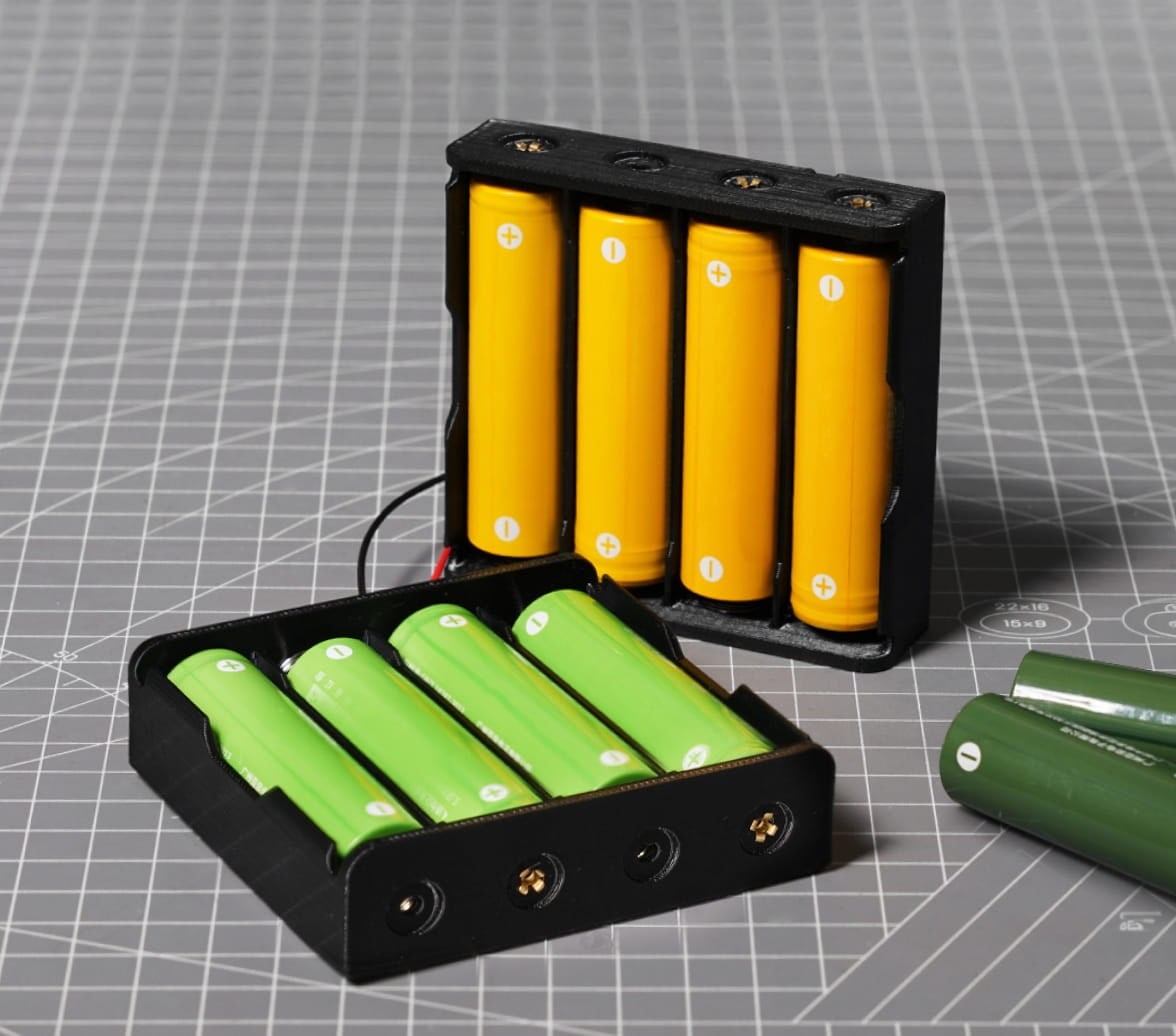
Yes, in PC FR, which our materials page lists for battery boxes. The box is a printed part with no rating of its own. Tell us the wall thickness you need and send the file.
PC FR or PPS-CF for a hot part?
PPS-CF: heat deflection 235 °C against 108 °C at 1.8 MPa (ISO 75), and "Resistant" to acids, alkalis, organic solvents and oils. Bambu Lab publishes no flame class for it, and it is brittle across its layers (2.8 kJ/m²), so if the drawing names a class and the part is not hot, PC FR.
How big can a PC FR or PPS-CF part be?
340 x 320 x 340 mm in one piece for either, because both need a heated chamber.

Send the file and say which class the drawing names
Send the file and write what the part does and whether a flame class, a temperature or a chemical is in the spec. A person picks PC FR or PPS-CF and replies with a price in 3 hours on average on workdays.