TPU 3D printing: firm 68D or soft 95A
We print TPU for AMS, a firm Shore 68D TPU, from our usual range, and order in the soft grades, TPU 95A HF, 90A and 85A, for parts that must stretch across their layers. The four are not one material in four hardnesses: on Bambu Lab's datasheets TPU for AMS is about 120 times stiffer than TPU 95A HF along the layers and breaks at 31% stretch across the layers, where the A grades pass 350%.
- TPU for AMS: Shore 68D, 1,190 MPa modulus along the layers
- TPU 95A HF: 9.8 MPa modulus, past 480% stretch across the layers
- TPU for AMS 2-5 working days after payment; the A grades ordered in
- Up to 340 x 320 x 340 mm in one piece
Which TPU should I choose, 68D or 95A?
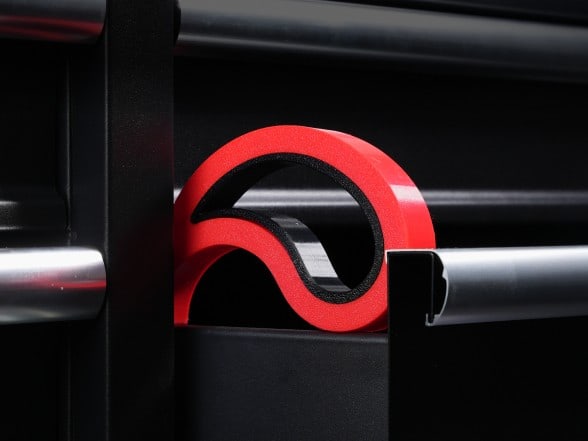
Choose TPU for AMS, Shore 68D, for a firm part that takes knocks and keeps its shape: bumpers, feet, grips, cable guides. It is one of our most popular materials, usually 2-5 working days after payment.
Choose a Shore A grade, TPU 95A HF first, for anything that must stretch, squeeze or bend across its layers: grommets, soft seals, straps, buffers. The A grades are ordered in for the job; the quote gives the time.
68D and 95A are different scales
Shore A and Shore D are two hardness scales for two kinds of material. Shore A is used for soft materials, Shore D for harder ones. One lab-equipment supplier's conversion table pairs the top of the Shore A scale, 100 A, with 58 D. So 68D sits past the top of the Shore A scale, and "68D is about 95A" is not a sentence the scales support.
The datasheets say the same thing in megapascals. TPU for AMS has a Young's modulus of 1,190 MPa along the layers (ISO 527); TPU 95A HF has 9.8 MPa. That is about 120 times. TPU for AMS flexes like a tough plastic, not like rubber. Bambu Lab's own words for it: "impressive toughness" with "TPU's signature flexibility".
The four side by side
Figures from Bambu Lab's datasheets (all TDS V1.0), measured on printed specimens at 100% infill and given "for design reference and comparison only". X-Y is along the layers, Z across them. The last row is Bambu Lab's own printability rating from its product pages.
| TPU for AMS | TPU 95A HF | TPU 90A | TPU 85A | |
|---|---|---|---|---|
| Our status | TPU for AMSmost popular | TPU 95A HFordered in | TPU 90Aordered in | TPU 85Aordered in |
| Shore hardness | TPU for AMS68D (datasheet) | TPU 95A HF95A (grade name) | TPU 90A90A (grade name) | TPU 85A85A (grade name) |
| Young's modulus, X-Y / Z (ISO 527) | TPU for AMS1,190 / 600 MPa | TPU 95A HF9.8 / 7.4 MPa | TPU 90A5.3 / 4.4 MPa | TPU 85A6.8 / 5.2 MPa |
| Tensile strength, X-Y / Z (ISO 527) | TPU for AMS22.4 / 11.2 MPa | TPU 95A HF27.3 / 22.3 MPa | TPU 90A12.5 / 10.1 MPa | TPU 85A12.0 / 10.5 MPa |
| Elongation at break, X-Y / Z (ISO 527) | TPU for AMS> 650% / 31% | TPU 95A HF> 650% / > 480% | TPU 90A> 650% / > 350% | TPU 85A> 700% / > 350% |
| Impact strength, X-Y / Z (ISO 179) | TPU for AMS124.3 / 9.6 kJ/m² | TPU 95A HF123.2 / 86.3 kJ/m² | TPU 90A124.2 / 87.3 kJ/m² | TPU 85A124.3 / 88.5 kJ/m² |
| Saturated water absorption (25 °C, 55% RH) | TPU for AMS1.20% | TPU 95A HF1.08% | TPU 90A0.61% | TPU 85A0.67% |
| Bambu Lab printability rating | TPU for AMS4.0 / 5 | TPU 95A HF2.5 / 5 | TPU 90A2.0 / 5, con "Difficult to Print" | TPU 85A1.5 / 5, con "Difficult to Print" |
What is the same in all four, said once: heat deflection, Vicat softening and bending modulus read "N/A"; acids and alkalis "Not resistant"; "Not resistant to some organic solvents"; "Resistant to most kinds of oil and grease"; flammability "Flammable". TPU for AMS and TPU 95A HF specimens were annealed and dried at 70 °C for 12 hours before testing; TPU 90A and 85A were dried, not annealed.
One row to read with care: within the A grades, softness follows the Shore number, not the modulus. TPU 85A's datasheet modulus (6.8 MPa) is above TPU 90A's (5.3 MPa), and Bambu Lab still calls 85A "the softest TPU in Bambu Lab's lineup". Pick an A grade by its Shore number and its use.
Across the layers
This is the row the hardness charts leave out. TPU for AMS stretches past 650% along its layers and 31% across them; its impact strength is 124.3 kJ/m² along and 9.6 across. The A grades keep their stretch in both directions: past 480% across the layers for TPU 95A HF, past 350% for 90A and 85A, with 86.3 to 88.5 kJ/m² impact across.
For your part: anything that stretches or bends so that its layers open, a strap, a living hinge, a grommet pushed through a hole, a seal squeezed in a groove, wants an A grade. A firm part loaded along its layers, a bumper, a foot, a cable guide, is where TPU for AMS belongs.
TPU 95A HF is also the strongest across the layers: 22.3 MPa against 10.1 to 11.2 for the other three grades. Bambu Lab lists "exceptional interlayer adhesion, impact resistance, flexibility, and cold-temperature resilience" for it; no figure is given for the cold, so we quote the words and nothing more. For how the four compare with rigid materials on this axis, see Layer strength: X-Y vs Z.
Which grade for which part
- TPU for AMS, Shore 68DBumpers, feet, grips, cable guides, firm seals that only locate, a guard that takes knocks. One of our most popular materials, usually 2-5 working days after payment. Design walls of 1.5 mm or more.
- TPU 95A HFGrommets, straps, soft seals, buffers, anything pushed, stretched or bent across its layers: past 480% elongation and 86.3 kJ/m² impact in Z, and 22.3 MPa tensile across the layers, the highest among the four grades. Ordered in for the job; the quote gives the time.
- TPU 90A and TPU 85ACushions, soft covers and pads. Bambu Lab places 90A in "shoe soles, RC tires, and functional components that require both flexibility and strength" and 85A in "protective cases, squishy fidget toys, and soft cushioning elements". Both carry Bambu Lab's "Difficult to Print" con. Ordered in; ask for two grades in one request and the quote prices each.
What TPU will not do
- HeatNo TPU datasheet gives a heat deflection or softening temperature; the rows read "N/A". Bambu Lab's own heat rating is 1.5 out of 5 for TPU for AMS and TPU 95A HF and 0 out of 5 for TPU 90A and 85A. A flexible part near an engine or a heater is a part you test, and we say so before the price.
- ChemicalsAll four are "Not resistant" to acids and alkalis and "Not resistant to some organic solvents". They are "Resistant to most kinds of oil and grease", which is why an oily grip or a cable guide in a workshop is fine. For the full set of rows, see Chemical and oil resistant 3D printing filament.
- A guaranteed sealNo datasheet gives a compression or sealing figure for any TPU. Where a standard O-ring or a moulded gasket exists, buy it; we print the custom shape next to it, in an A grade, and you test it in place. We do not promise that a printed seal holds pressure.
- Softer than 85A, or food contactBambu Lab calls TPU 85A "the softest TPU in Bambu Lab's lineup"; nothing softer is in our catalogue. And no printed part of ours is called food-safe.
What we print most
TPU for AMS is among our most popular materials, so it usually prints in 2-5 working days after payment. TPU 95A HF, TPU 90A and TPU 85A are ordered in for the job; the quote gives the time. The four grades print without a heated chamber, so the largest TPU part in one piece is 340 x 320 x 340 mm.
Buyers of flexible parts tend to tell us what they need in their own words: "rubber-like", "elastic", a TPU grade by name, and one sent a Shore hardness chart. Any of those works. Say what the part does, how far it must bend and what it touches, and a person picks the grade before the price. Tolerance ±0.5%, minimum ±0.5 mm. Posted to the Baltics, Finland, Sweden and Denmark.
Questions
Checked by the druckworks workshopUpdated
Is TPU for AMS soft?
No. It is Shore 68D, past the top of the Shore A scale, with a Young's modulus of 1,190 MPa along the layers (ISO 527). It flexes like a tough plastic. For a soft part, ask for TPU 95A HF, 90A or 85A.
TPU 95A or 85A?
95A HF for a part that must also be strong across its layers (22.3 MPa tensile, past 480% stretch); 85A for the softest cushion or pad, which Bambu Lab calls "the softest TPU in Bambu Lab's lineup". Both are ordered in.
Is TPU waterproof?
The material is insoluble in water and takes up 1.08 to 1.20% at saturation in TPU for AMS and TPU 95A HF. Whether a printed part keeps water out depends on its design and its walls, not on the material; we do not promise a watertight print.
TPU or PETG?
If the part must bend, TPU. If it must hold its shape and size, PETG HF, which is 24/7 PETG in white. A firm part that bends a little is TPU for AMS.
Does TPU resist oil?
Bambu Lab's datasheets read "Resistant to most kinds of oil and grease" for all four grades, and "Not resistant" to acids, alkalis and some organic solvents.
How hot can a TPU part get?
No datasheet says. Heat deflection and Vicat softening read "N/A" for all four grades, so we give no limit. Tell us the temperature and a person says whether to test it or pick another material.
How big can a TPU part be?
Up to 340 x 320 x 340 mm in one piece, for all four grades.

Send the file and say how far the part must bend
Send the file and say what the part does: a firm bumper or a seal that squeezes. A person picks between TPU for AMS and the A grades and replies with a price in 3 hours on average on workdays.