Asked for PA12? The FDM alternatives
A drawing that says PA12 was usually written for a powder bed. We print FDM, not SLS or MJF, so this page says what comes closest on the datasheet, by how much it differs, and when you should keep the part with a powder service instead.
- PAHT-CF: Bambu Lab's PA12 blend with carbon fibre, ordered in
- PPA-CF and PETG HF usually 2-5 working days after payment
- A person checks every file, and says when FDM is not the answer
- Posted to the Baltics, Finland, Sweden and Denmark
What can I print instead of PA12?
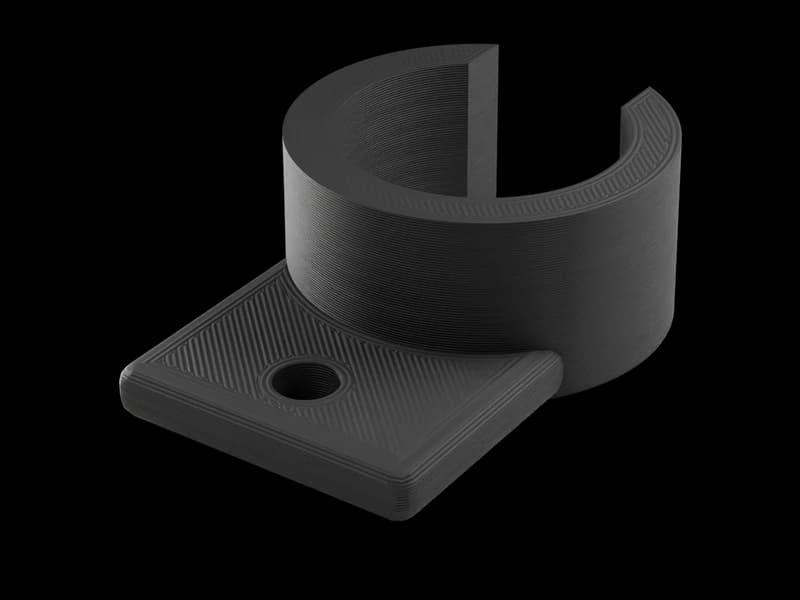
If PA12 was the bureau's default and the part is a housing, a cover or a bracket at room temperature, print it in PETG HF or PPA-CF and test one. If it relied on PA12's toughness or flex, PAHT-CF is the closest FDM match, ordered in: Bambu Lab builds it on PA12 and adds carbon fibre.
If the part is loaded in every direction, full of internal channels, or specified as PA12 by a standard, an SLS or MJF service is the right shop, not us.
Why the drawing says PA12
PA12 is the standard powder of SLS and MJF, so a drawing or an RFQ written for a powder bureau says PA12 by default, not because the part needs that polymer. The requirement behind it is usually a tough engineering plastic that holds its shape.
About 3 in 10 of our 2026 enquiries name a material before we ask, and PA12 is one of the names that comes up, next to PETG, ABS and PC. When the material named is one we do not print, the talk turns to which of ours does the job, and buyers have asked for one sample part to prove it.
The FDM options, on the datasheet
We hold no datasheet for unfilled PA12 or for powder-bed PA12, so there is no PA12 column: the table compares what we print with each other. Figures are Bambu Lab's test-specimen values, given "for design reference and comparison only". X-Y is along the layers, Z across them.
| PAHT-CF | PPA-CF | PA6-CF | PETG HF | |
|---|---|---|---|---|
| Our status | PAHT-CFordered in | PPA-CFmost popular | PA6-CFordered in | PETG HFmost popular, our 24/7 white line |
| Composition (datasheet) | PAHT-CFPA 12 and other long-chain PA, carbon fibre | PPA-CFSemi-aromatic nylon, carbon fibre | PA6-CFNylon 6, carbon fibre | PETG HFPETG |
| Tensile strength, X-Y / Z (ISO 527) | PAHT-CF92 / 47 MPa | PPA-CF168 / 57 MPa | PA6-CF102 / 48 MPa | PETG HF34 / 23 MPa |
| Elongation at break, X-Y / Z (ISO 527) | PAHT-CF8.4 / 4.1% | PPA-CF3.2 / 0.9% | PA6-CF5.8 / 3.7% | PETG HF8.6 / 5.1% |
| Impact strength X-Y, unnotched / notched (ISO 179) | PAHT-CF57.5 / 22.8 kJ/m² | PPA-CF41.7 / 6.5 kJ/m² | PA6-CF40.3 / 13.4 kJ/m² | PETG HF31.5 / 6.2 kJ/m² |
| Impact strength Z (ISO 179) | PAHT-CF13.3 kJ/m² | PPA-CF4.3 kJ/m² | PA6-CF15.5 kJ/m² | PETG HF10.6 kJ/m² |
| Heat deflection at 1.8 MPa (ISO 75) | PAHT-CF170 °C | PPA-CF196 °C | PA6-CF164 °C | PETG HF62 °C |
| Saturated water absorption (25 °C, 55% RH) | PAHT-CF0.88% | PPA-CF1.30% | PA6-CF2.35% | PETG HF0.40% |
| Largest part in one piece | PAHT-CF340 x 320 x 340 mm | PPA-CF340 x 320 x 340 mm | PA6-CF340 x 320 x 340 mm | PETG HF340 x 320 x 340 mm |
Conditioning differs: the PAHT-CF and PA6-CF specimens were annealed and dried at 80 °C for 12 hours, PETG HF at 75 °C for 8 hours, and PPA-CF was tested as printed. A powder-bed PA12 part is a different thing again: its properties are far more even in every direction, with no layer line to cross a load. We quote no figure for it.
Which one, when
- PAHT-CFThe chemistry match. The toughest in the table along the layers (57.5 kJ/m² unnotched, 22.8 notched), the most stretch of the nylons (8.4%) and the lowest water uptake of them (0.88%); Bambu Lab says it was "optimized to retain excellent mechanical properties when wet" and has "enhanced Z-bonding". The pick when the PA12 part was chosen for toughness, a snap-fit or a damp place. Ordered in; the quote gives the time.
- PPA-CFThe upgrade, not the match. Far stiffer and stronger (168 MPa tensile, 9,860 MPa bending modulus along the layers, ISO 178) with 196 °C heat deflection, but it stretches 3.2% before breaking and takes 4.3 kJ/m² across the layers. A clip or snap-fit drawn for PA12 may crack in PPA-CF where PA12 bent. The pick for a bracket, a jig or a housing that must be stiff. Most popular, so usually the fastest.
- PA6-CFIn between on strength (102 MPa), the highest impact across the layers (15.5 kJ/m²), the highest water uptake (2.35%); Bambu Lab places it in "structural parts used in dry environments". Ordered in. For the three nylons side by side, see Carbon fibre nylon.
- PETG HFWhen PA12 was only the bureau default for a cover, a housing or a tray at room temperature. Not a nylon: 34 MPa tensile, 62 °C heat deflection at 1.8 MPa, 0.40% water. Our printers run white PETG around the clock, so there is no changeover to wait for; usually 2-5 working days after payment, and a single part is a real order.
When SLS or MJF is the right shop, not us
We do not run SLS or MJF. In these cases a powder service is the better answer, and we say so in the reply:
- The part is loaded in every direction, or across what would be our layers. Our tensile strength across the layers is 34% of the along-layer figure for PPA-CF, 51% for PAHT-CF and 68% for PETG HF (from the table above).
- Internal channels, enclosed cavities or a lattice that FDM cannot support from below.
- Many small identical parts in one batch; a powder bed nests them.
- The spec, an approval or a validated test says PA12 itself. Our parts carry no formal approval, so a substitute would not pass that paperwork.
- A tolerance tighter than ±0.5% (minimum ±0.5 mm), or a surface without layer lines.
- Living hinges and thin flexures designed for PA12.
We quote no SLS or MJF figures or prices here; we do not run the process. If the list above describes your part, say so, and the reply says whether a powder service is the better shop.
Order one part first
A substitute is proven in the part, not on paper. Order one in the material the table points to, fit it in place of the PA12 part, load it, wet it, leave it in the warm. One part is a real order, and the batch can follow once it passes. Buyers who named a material we do not print have asked for a sample before the batch, and it is the round we suggest.
Send the drawing as it is, PA12 and all. Say what the part does, how warm it gets, whether it gets wet and whether it has to flex. A person reads it and replies with the closest material and a price in 3 hours on average on workdays.
Questions
Checked by the druckworks workshopUpdated
Can you print PA12?
Not unfilled PA12 as a routine material, and no powder PA12: we print FDM only. PAHT-CF is Bambu Lab's PA12-based filament with carbon fibre, ordered in for the job.
Is PAHT-CF the same as PA12-CF?
Bambu Lab's is a PA12 blend: "PA 12 and other long-chain PA, carbon fiber". Other brands use PAHT-CF for PPA- or PA6-based filament, so check whose datasheet a drawing means. Our figures are Bambu Lab's.
Is an FDM part as strong as SLS PA12?
Not in every direction. An FDM part is weaker across the layers: PAHT-CF keeps 51% of its tensile strength in Z, PPA-CF 34%. Along the layers PPA-CF is a stiff, strong part. We hold no powder PA12 datasheet, so we give no figure for it.
Does PAHT-CF absorb water?
0.88% at saturation (25 °C, 55% RH), the lowest of the nylons we print; PA6-CF takes 2.35%, PPA-CF 1.30%. Bambu Lab says PAHT-CF keeps its properties when wet; no datasheet gives a wet-strength figure, so we quote none.
Which is closest to PA12 for a snap-fit?
PAHT-CF: 8.4% elongation at break and 22.8 kJ/m² notched impact along the layers. PPA-CF stretches 3.2% and may crack where PA12 bent. Orient the clip so it flexes along the layers, and test one.
How fast?
PPA-CF and PETG HF are among our most popular materials: usually 2-5 working days after payment. PAHT-CF and PA6-CF are ordered in; the quote gives the time.

Drawing says PA12?
Send it as it is. A person names the closest FDM material, or tells you that a powder service is the better shop, and replies with a price in 3 hours on average on workdays.