Jigs, fixtures and gauges, printed
Holders, nests, drill guides and go/no-go gauges for the bench, printed from a file. Pick the material by stiffness, size stability and heat; design the datum for a tolerance of ±0.5%, minimum ±0.5 mm.
- From a single fixture, no account
- Stiff carbon-fibre materials on our most popular list
- Largest part 360 x 360 x 360 mm (340 x 320 x 340 mm in carbon-fibre and heated-chamber materials)
- A person checks the file before a price
What prints well as tooling
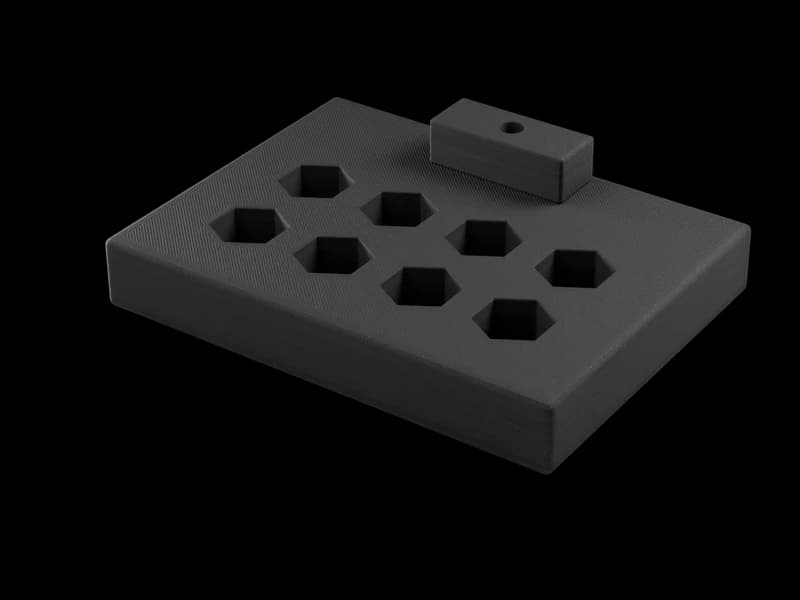
- Holders and nestsThat locate a part for assembly, gluing or inspection.
- Drill and cut guidesThat put a bought hardened bushing in a printed body.
- Go/no-go gaugesThat tell an operator whether a part is roughly right.
- Assembly aids and clamp blocksWhere the load is a hand, not a press.
- Covers, guards and cable holdersFor a workstation.
These are one-off or small-run parts in plastic, which is where FDM is quick. Orders start from one part; the price comes from a person.
Material by shop-floor condition
Figures from Bambu Lab's datasheets for PETG HF, PET-CF, PPA-CF and PPS-CF, measured on test specimens, "for design reference and comparison only".
| PETG HF | PET-CF | PPA-CF | PPS-CF | |
|---|---|---|---|---|
| Our status | most popular (24/7 WHITE PETG) | most popular | most popular | most popular |
| Bending modulus X-Y / Z (ISO 178) | 2,050 / 1,810 MPa | 5,320 / 2,210 MPa | 9,860 / 3,240 MPa | 7,160 / 2,460 MPa |
| Tensile strength X-Y / Z (ISO 527) | 34 / 23 MPa | 74 / 35 MPa | 168 / 57 MPa | 87 / 24 MPa |
| Heat deflection, 1.8 MPa (ISO 75) | 62 °C | 182 °C | 196 °C | 235 °C |
| Saturated water absorption | 0.40% | 0.37% | 1.30% | 0.05% |
| Largest part | 360 x 360 x 360 mm | 340 x 320 x 340 mm | 340 x 320 x 340 mm | 340 x 320 x 340 mm |
- PETG HFFor a quick, plain fixture that sits at room temperature. It is 24/7 WHITE PETG, so there is no colour change to wait for.
- PET-CFPET with carbon fibre, for when the nest must stay stiff and keep its size: 2.6 times the bending modulus of PETG HF, and 0.37% water.
- PPA-CFWhen stiffness and strength decide: the highest in this table. Mind the water: 1.30% saturated uptake means more size change in a damp hall than PET-CF or PPS-CF.
- PPS-CFWhen the fixture sees heat or solvent: 235 °C at 1.8 MPa, "Resistant" to acid, alkali, solvent, oil and grease in its datasheet, and 0.05% water, the lowest uptake in the catalogue.
If the fixture runs through an oven, a curing step or a hot assembly, name the temperature. HDT is a specimen test, not a working limit; tell us the temperature and the load.
Tolerance and the datum
Our tolerance is ±0.5%, minimum ±0.5 mm. On a 100 mm feature that is ±0.5 mm. On a 200 mm nest it is ±1.0 mm. Design the fixture around it:
- One datumDimension every locating feature from the same face, so errors do not stack.
- Adjustable where it countsWhere one feature sets the part's position, give it a slot, a shim or a set screw. Print the rough location, set the final one by hand.
- Bought parts for the fine fitDowel pins, hardened bushings and threaded inserts go in printed holes. The fit is made by the bought part, not by the print.
- Gauges are go/no-goA printed gauge says whether a part is roughly right to about ±0.5 mm. It is not a measuring tool, and it comes with no calibration or certificate. Check tight dimensions with a calibrated instrument.
- Load across the layersEvery material above is weaker across the layers: PET-CF 35 MPa against 74 MPa, PPA-CF 57 against 168, PPS-CF 24 against 87 (ISO 527). Tell us where the clamp pulls and we orient the part so the load runs along the layers.
Sending the part and the requirement
Send the STEP of the part the fixture holds. Add what the fixture must do: where the part is located and clamped, the load, the temperature and any coolant, oil or cleaner on the bench. Add the quantity: one per station is common.
If you have no fixture model, send a sketch or a few sentences with the part's file. We draw the fixture, you approve the model, then it prints. The quote names the modelling next to the print; there is no published rate.
Most popular materials usually print in 1-3 working days on average after you approve. The quote gives the date for your fixture.
When to machine it instead
- A locating feature that needs ±0.1 mm.
- A wear surface that sees hardened parts sliding on it every cycle.
- A clamp that needs more force than plastic carries.
- Heat above what PPS-CF holds, or any metal part.
We print FDM plastic only and we do not machine. In those cases a machine shop is the right call, and a printed prototype of the fixture can still prove the layout first.
Questions
Which filament for a shop-floor fixture?
PETG HF for a quick, plain one; PET-CF when it must stay stiff and keep its size; PPS-CF for heat or solvents. The table above carries the datasheet figures.
Can a printed gauge be calibrated?
We do not offer calibration or a measurement certificate. A printed gauge is a go/no-go check at about ±0.5 mm.
How accurate is a printed fixture?
Our tolerance is ±0.5%, minimum ±0.5 mm. Fine fits come from bought pins and bushings in printed holes.
How big can a fixture be?
360 x 360 x 360 mm in one piece, 340 x 320 x 340 mm in carbon-fibre and heated-chamber materials. Bigger ones are printed in sections designed to be joined.
Can you design the fixture?
Send the part's file, or photos with measurements, and a sketch. We draw the fixture, you approve it, we print.
What if the part is hot?
PPS-CF deflects at 235 °C under 1.8 MPa (ISO 75); for higher, the fixture is metal.

A fixture for your line?
Send the part's file and say what the fixture must hold. A person replies with a price in 3 hours on average on workdays.